

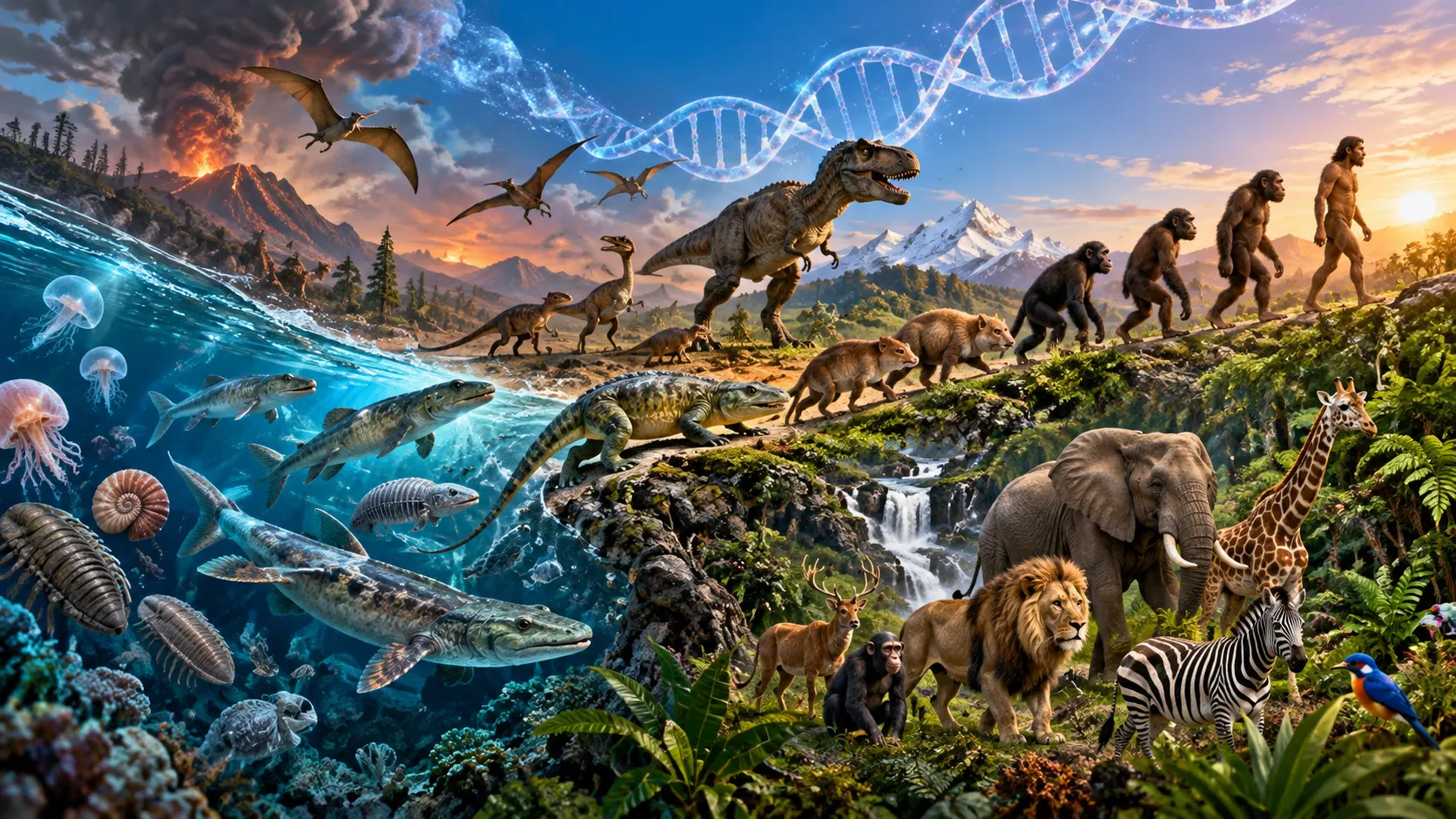
Life on Earth is incredibly diverse, with millions of species displaying different shapes, sizes, behaviors, and survival strategies. From tiny microorganisms to enormous mammals, every living organism has a history connected to earlier generations. Understanding how evolution works helps explain why living things are different today and how species have changed throughout Earth’s long biological history.
Evolution is the process through which inherited characteristics of populations change across generations. These changes occur through mechanisms such as genetic mutations, natural selection, genetic drift, and gene flow. Over many generations, evolutionary processes can produce new adaptations, increase biological diversity, and sometimes contribute to the formation of entirely new species.
Learning why species change over time provides valuable insights into genetics, ecosystems, biodiversity, and the relationships between organisms. Evolution is not a process in which animals deliberately transform because they need new abilities. Instead, inherited variation and changes in reproduction influence which characteristics become more or less common within populations.
What Is Evolution in Biology?
Evolution in biology refers to changes in inherited characteristics within populations over successive generations. These changes occur when genetic variants become more or less common over time. Evolution explains how organisms are connected through common ancestry and why populations can gradually develop different characteristics under different environmental conditions.
A population consists of individuals belonging to the same species that live within a particular area or reproductive group. Individuals vary in their inherited traits, including physical features and certain physiological characteristics. When the frequencies of these inherited variations change across generations, evolutionary change has occurred within that population.
Evolution does not mean that every individual organism changes its genetic characteristics during its lifetime. Instead, evolutionary processes operate across generations as inherited information is passed from parents to offspring. Understanding this distinction is essential because individual growth, learning, and temporary responses to environmental conditions are not automatically examples of biological evolution.
How Does Evolution Work Step by Step?
Evolution begins with genetic variation among individuals within a population. This variation arises through mutations, recombination during sexual reproduction, and the inheritance of different genetic combinations. Because individuals are not genetically identical, they may differ in characteristics that affect reproduction, survival, or other biological functions.
Different evolutionary mechanisms influence how these genetic variations are passed to future generations. Natural selection can increase the frequency of inherited traits associated with reproductive success in a particular environment. Genetic drift, migration, and new mutations can also change genetic variation, even when the changes do not provide an obvious survival advantage.
Over many generations, accumulated genetic differences may produce noticeable changes in a population. Some changes are small, while others contribute to major differences between descendant populations. Evolution has no predetermined final goal, and the direction of change depends on genetic variation, environmental conditions, chance events, and reproductive patterns.
What Is Natural Selection and How Does It Work?
Natural selection is an evolutionary process in which individuals with certain inherited characteristics leave more surviving offspring than others in a particular environment. When those characteristics are passed to descendants, they may become increasingly common across generations. This process helps explain how populations develop adaptations suited to particular environmental conditions.
Consider a population of insects with inherited differences in body color. If certain colors make insects harder for predators to notice, individuals with those colors may survive and reproduce more successfully. Over several generations, the inherited color associated with greater reproductive success could become more common within the population.
Natural selection does not create traits because organisms consciously want or need them. It acts on existing inherited variation, although new mutations continually introduce additional possibilities. A characteristic that provides an advantage in one environment may become less useful when conditions change, making natural selection dependent on circumstances rather than permanent superiority.
Why Do Species Change Over Time?
Species change over time because genetic variation interacts with environmental conditions, reproduction, and chance events. Changes in climate, food availability, predators, diseases, and habitats may influence which inherited characteristics contribute to reproductive success. Populations can also evolve through genetic drift and gene flow without any particular environmental improvement.
For example, when a habitat becomes drier, plants with inherited characteristics that help them tolerate limited moisture may reproduce more successfully. If these traits are heritable, their frequency may increase across generations. However, the outcome depends on the variation already present and whether other evolutionary processes affect the population.
Not every evolutionary change produces an obvious physical difference or makes organisms more complex. Some changes involve genetic variants that have little effect on appearance or reproductive success. Evolution is therefore a continuing process shaped by multiple mechanisms rather than a simple progression toward stronger, larger, or supposedly better species.
How Genetic Mutations Contribute to Evolution
Genetic mutations are changes in DNA sequences that can introduce new inherited variation into populations. They may occur during DNA replication or through other biological processes. Mutations can affect individual genes, larger chromosome regions, or the organization of genetic information, creating potential differences between individuals and their descendants.
The effects of mutations vary considerably depending on where they occur and how they influence biological functions. Some mutations have little noticeable effect, while others can be harmful or occasionally beneficial in particular circumstances. Mutations are not produced specifically to solve environmental problems, although natural selection may influence their frequency afterward.
When mutations occur in cells that contribute genetic material to offspring, they can become part of future generations. Over long periods, mutation and other sources of genetic variation provide material for evolutionary change. Without heritable variation, natural selection would have limited opportunities to shift characteristics within populations.
The Role of Genetic Variation in Evolution
Genetic variation describes differences in inherited DNA sequences among individuals within a population. These differences contribute to variation in many biological characteristics, including coloration, metabolism, and resistance to particular diseases. Populations with genetic diversity may have multiple inherited characteristics that respond differently when environmental conditions change.
Sexual reproduction creates new combinations of genetic variants through processes such as recombination and the independent assortment of chromosomes. Offspring inherit combinations of genetic material from their parents, contributing to differences among individuals. Mutations add new variants, while migration can introduce genetic diversity from other populations.
Genetic variation is important because evolutionary mechanisms affect the frequencies of inherited variants over time. However, high genetic diversity does not guarantee that a population will survive every environmental challenge. Survival also depends on population size, ecological conditions, reproductive success, and the availability of suitable adaptations.
How Adaptation Helps Species Survive
An adaptation is an inherited characteristic that developed through natural selection because it contributed to reproductive success in a particular environment. Adaptations may involve physical structures, physiological processes, or inherited behavioral tendencies. They help explain why organisms possess characteristics that appear well suited to their habitats and ecological roles.
For example, desert plants may have inherited features that limit water loss, while certain animals possess coloration that provides camouflage. These characteristics can improve reproductive success under particular environmental conditions. However, adaptations often involve trade-offs, meaning a feature that offers one advantage may also have costs.
Adaptation should not be confused with temporary adjustments made by individual organisms during their lifetimes. A person becoming accustomed to a warmer climate is not necessarily experiencing genetic evolution. Evolutionary adaptations involve inherited characteristics becoming more common across generations through natural selection rather than individuals intentionally changing their biological traits.
What Is Genetic Drift in Evolution?
Genetic drift is the change in genetic variant frequencies caused by random differences in reproduction and survival. Unlike natural selection, genetic drift does not require a particular inherited characteristic to provide an advantage. It can influence any population, although its effects are generally stronger in smaller populations.
Imagine a small population in which some individuals happen to reproduce more than others for reasons unrelated to their inherited characteristics. The genetic variants carried by those individuals may become more common simply through chance. Over generations, some variants may disappear entirely while others become fixed within the population.
Genetic drift can become especially important after population bottlenecks or founder events. A bottleneck occurs when a population experiences a substantial reduction in size, while a founder event begins when a small group establishes a new population. Both situations can change genetic diversity and influence future evolutionary patterns.
How Gene Flow Changes Populations
Gene flow occurs when genetic variants move between populations through migration and reproduction. It can happen when individuals relocate and reproduce with members of another population. In plants, pollen or seeds may also transfer genetic material between populations, depending on the species and reproductive system.
When gene flow introduces new genetic variants, it may increase genetic diversity within the receiving population. It can also make populations more genetically similar by exchanging inherited characteristics. The effects depend on migration rates, population sizes, reproductive compatibility, and how introduced variants interact with existing genetic variation.
Gene flow plays an important role in understanding why some populations remain connected while others gradually become genetically different. Geographic barriers, changes in habitat, and reproductive behaviors can limit genetic exchange. Reduced gene flow may allow differences to accumulate, potentially contributing to the formation of new species over time.
How New Species Form Through Evolution
Speciation is the evolutionary process through which populations diverge and become separate species. It often involves changes that reduce or prevent successful reproduction between populations. These differences may develop through genetic changes, environmental pressures, geographic separation, or a combination of several evolutionary mechanisms.
Geographic isolation can occur when mountains, rivers, oceans, or other barriers separate populations. Over time, natural selection, genetic drift, and mutations may cause the isolated groups to develop different characteristics. If reproductive barriers eventually develop, the populations may remain distinct even when they come into contact again.
New species can also develop without complete geographic separation, particularly under certain ecological or reproductive conditions. In plants, changes involving chromosome numbers can sometimes contribute to relatively rapid speciation. The process varies among organisms, and there is no universal period required for new species to emerge.
What Is the Difference Between Microevolution and Macroevolution?
Microevolution describes evolutionary changes occurring within populations, such as shifts in the frequencies of inherited genetic variants. These changes may happen across relatively short periods and can sometimes be observed directly. Examples include changes in insecticide resistance or differences in inherited characteristics across generations of an experimental population.
Macroevolution refers to broader evolutionary patterns, including speciation, extinction, and changes across major groups of organisms over long periods. It examines how evolutionary processes contribute to the diversity and history of life. Fossils, genetic comparisons, and evolutionary relationships provide important evidence for studying these large-scale patterns.
Microevolution and macroevolution are not separate biological systems operating according to unrelated principles. Both involve evolutionary processes that affect inherited variation and populations. The main distinction concerns the scale of the patterns being studied, although understanding macroevolution also requires considering speciation, extinction, and long-term ecological changes.
What Evidence Supports the Theory of Evolution?
Evolution is supported by several independent lines of scientific evidence, including fossils, genetics, comparative anatomy, and observed changes in living populations. These different sources help researchers reconstruct evolutionary relationships and test explanations of biological change. Their agreement provides strong support for common ancestry and the processes responsible for evolutionary diversity.
The fossil record documents organisms that lived in earlier geological periods and reveals changes in life across Earth’s history. Comparative anatomy identifies structural similarities that may reflect shared ancestry. Molecular evidence, including comparisons of DNA sequences, provides additional information about evolutionary relationships among species.
Scientists have also observed evolutionary changes directly in organisms with relatively short generation times. Studies of microorganisms, insects, and other populations demonstrate changes in inherited characteristics across generations. Evolutionary theory continues to develop as researchers collect new evidence, refine models, and investigate the mechanisms underlying biological diversity.
How Fossils Explain Evolutionary History
Fossils preserve evidence of organisms that lived in the past, including bones, shells, footprints, and other biological traces. They provide valuable information about ancient environments, extinct species, and changes in biological characteristics through geological time. Fossils are particularly useful for investigating evolutionary transitions that occurred long before direct scientific observation.
Scientists study fossil locations, rock layers, anatomical structures, and geological ages to understand when organisms existed. Radiometric dating and other geological methods help establish the ages of suitable rocks and fossil-bearing formations. Comparing fossils from different periods can reveal patterns of appearance, diversification, and extinction.
The fossil record is incomplete because fossilization requires particular conditions and many organisms leave no preserved remains. Nevertheless, discoveries from different regions and geological periods provide extensive evidence of evolutionary history. Fossil findings become especially informative when combined with genetic research and knowledge of living organisms.
How DNA Shows That Species Are Related
DNA contains inherited genetic information that influences the development and functioning of living organisms. Many species share genes and molecular processes because they inherited them from common ancestors. Comparing DNA sequences allows scientists to investigate evolutionary relationships and estimate how different groups are connected.
Closely related species often share more similarities in certain DNA sequences than more distantly related organisms. However, evolutionary relationships cannot always be determined from one gene because genes can have different histories. Researchers commonly analyze multiple genetic regions and use statistical methods to construct evolutionary trees.
Genetic evidence also reveals how populations change, exchange genes, and adapt to different environments. Molecular techniques have improved scientists’ understanding of both recent population changes and ancient evolutionary events. When genetic findings agree with fossils and anatomical evidence, they strengthen explanations of evolutionary history and common ancestry.
Examples of Evolution in Everyday Life
Evolution can be observed in populations of organisms that reproduce quickly or experience strong selection pressures. Antibiotic resistance in bacteria is a well-known example of evolutionary change. When resistant bacteria survive particular treatments and reproduce, inherited resistance characteristics may become more common within the bacterial population.
Insects can also evolve resistance to pesticides when inherited variants influence their ability to survive exposure. Repeated selection can change the frequency of these variants across generations. These examples demonstrate why evolution matters in agriculture, public health, and environmental management, particularly when human activities create new selection pressures.
Changes in the beak characteristics of certain bird populations provide another example of evolution in natural environments. Research involving Galápagos finches has documented changes associated with food availability and environmental conditions. Such observations help scientists understand how inherited variation and natural selection influence populations over relatively short periods.
How Environmental Changes Influence Evolution
Environmental conditions influence evolution by affecting survival, reproduction, and interactions among organisms. Temperature, rainfall, food availability, predators, competitors, and diseases can all contribute to selection pressures. However, environmental changes do not directly instruct organisms to develop specific beneficial mutations or adaptations.
When conditions change, some inherited characteristics may become more advantageous, while others may become less useful. Populations with suitable variation may respond through natural selection across generations. If environmental change occurs too quickly or suitable variation is absent, populations may decline or become extinct instead of adapting successfully.
Environmental pressures can also interact with migration, genetic drift, and other evolutionary mechanisms. For example, a changing habitat may isolate populations or alter which individuals successfully reproduce. Understanding these interactions is important for studying biodiversity, conservation biology, and the long-term responses of species to environmental challenges.
How Evolution Explains Biodiversity on Earth
Biodiversity refers to variation among living organisms, including differences within species, between species, and across ecosystems. Evolution helps explain how this diversity developed through common ancestry, genetic change, speciation, and extinction. Over billions of years, evolutionary processes have produced the wide variety of organisms found on Earth.
Different habitats create distinct ecological opportunities and challenges that influence evolutionary outcomes. Organisms may develop specialized characteristics through natural selection, while chance events and geographic isolation contribute to population differences. These processes can lead to the diversification of species occupying different ecological roles within an environment.
Biodiversity is also shaped by extinction, which removes evolutionary lineages and changes ecological communities. New species continually arise, while others disappear due to environmental and biological factors. Studying evolutionary history helps scientists understand present-day ecosystems and recognize the importance of protecting genetic diversity and natural habitats.
Does Human Evolution Still Happen Today?
Human evolution continues because inherited genetic variation still exists and populations continue to reproduce across generations. Natural selection, genetic drift, mutation, and gene flow remain relevant to human populations. Cultural and technological changes influence environments, but they do not eliminate the biological mechanisms responsible for evolution.
Researchers study examples such as inherited differences related to lactose digestion and adaptations associated with living at high altitudes. These characteristics demonstrate how human populations have responded to particular environmental and cultural conditions. However, genetic traits vary among individuals, and no human population represents a more advanced evolutionary stage than another.
Modern medicine, migration, education, and social environments can influence survival and reproduction, but human evolution remains complex. Evolution does not imply that every new generation becomes genetically superior to the previous one. Understanding human evolution requires considering population history, genetic diversity, changing environments, and the shared ancestry of all living humans.
Common Misconceptions About Evolution
One common misunderstanding is that evolution means individual organisms transform their bodies whenever environmental conditions change. In reality, biological evolution involves inherited changes in populations across generations. Individuals may learn new behaviors or adjust physiologically, but these changes are not automatically passed to offspring through genetic inheritance.
Another misconception is that evolution always produces stronger, smarter, or more complex organisms. Evolution has no universal direction or predetermined goal, and traits become common through several different mechanisms. Natural selection favors reproductive success under particular conditions rather than progress toward an imagined perfect organism.
People also sometimes misunderstand the scientific meaning of the word theory. In science, a theory is a well-supported explanatory framework that integrates evidence and generates testable predictions. Evolutionary theory explains observed biological changes and common ancestry through mechanisms studied using genetics, ecology, paleontology, and other scientific disciplines.
Why Understanding Evolution Is Important
Understanding evolution provides a foundation for studying biology because it connects genetics, ecology, anatomy, and the history of life. It explains why organisms share certain characteristics and how populations respond to changes over generations. This knowledge helps researchers investigate biological diversity and the relationships between living and extinct species.
Evolutionary principles also have practical applications in medicine, agriculture, and conservation. Understanding the evolution of antibiotic resistance can inform treatment strategies and public health decisions. Similarly, knowledge of inherited variation helps researchers study crop improvement, wildlife populations, and the ecological consequences of environmental change.
Learning about evolution also encourages scientific reasoning by showing how explanations are developed and tested using evidence. Researchers compare observations, evaluate competing hypotheses, and refine conclusions as new discoveries emerge. These methods make evolutionary biology an important subject for understanding both the natural world and the scientific process.
Conclusion
Evolution is the process through which inherited characteristics of populations change across generations. Natural selection, genetic mutation, genetic drift, and gene flow all contribute to evolutionary patterns. These mechanisms explain why organisms vary, how adaptations develop, and why populations can gradually become different from their ancestors.
Species change over time because genetic variation interacts with reproduction, environmental conditions, and chance events. Some evolutionary changes improve reproductive success in particular environments, while others occur without providing an obvious advantage. Over long periods, these processes can contribute to speciation, extinction, and the remarkable biological diversity found throughout Earth’s history.
Understanding how evolution works helps explain the relationships among living organisms and the evidence connecting present-day species with ancient ancestors. Fossils, genetic comparisons, and direct observations provide strong support for evolutionary theory. By studying these processes, scientists continue to discover how life changes and how evolutionary history influences the natural world today.
FAQs
What is evolution in simple words?
Evolution is the change in inherited characteristics of populations over generations. It occurs through processes such as natural selection, mutation, genetic drift, and gene flow, helping explain biological diversity.
Why do species evolve over time?
Species evolve because inherited genetic variation changes across generations through natural selection, chance events, mutations, and gene flow. Environmental conditions can influence which characteristics contribute to reproductive success.
What is the main difference between evolution and natural selection?
Evolution describes changes in inherited characteristics across generations, while natural selection is one mechanism that causes those changes. Evolution can also occur through genetic drift, mutation, and gene flow.
Can evolution happen within a few generations?
Yes, evolutionary changes can occur within a few generations, particularly in organisms that reproduce quickly. Changes in inherited resistance among bacterial populations provide a familiar example of relatively rapid evolution.
Is there scientific evidence that evolution happens?
Yes, extensive evidence supports evolution, including fossils, DNA comparisons, anatomical similarities, and observed genetic changes in populations. These independent findings help scientists explain common ancestry and biological change.