

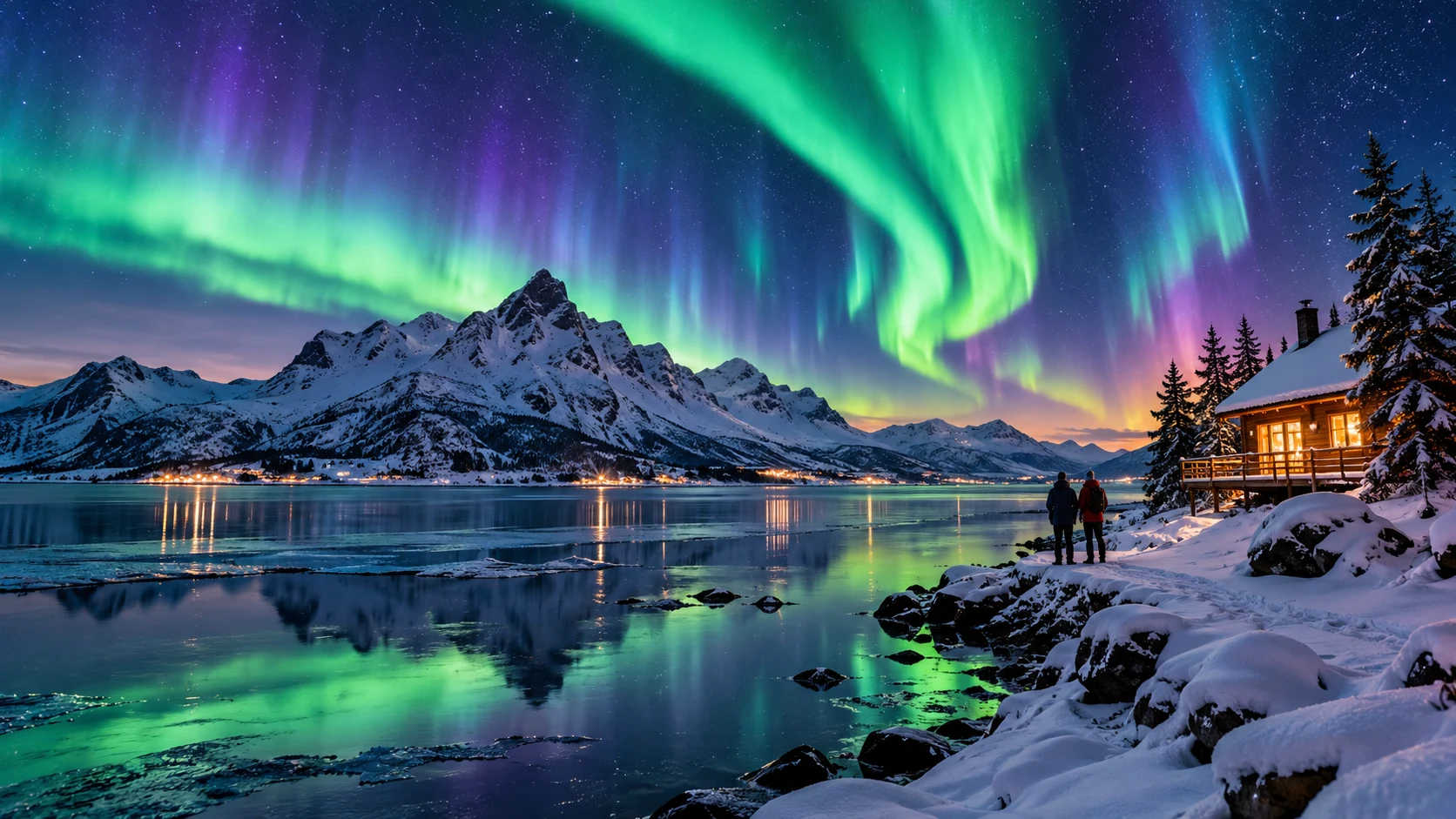
The Aurora Borealis, commonly known as the Northern Lights, is one of the most fascinating natural phenomena visible in Earth’s night sky. Colorful waves of green, purple, pink, and sometimes red light appear to dance above northern landscapes, creating unforgettable views. These beautiful displays attract travelers, photographers, and astronomy enthusiasts who want to experience one of nature’s most remarkable events.
Understanding what causes Aurora Borealis and where you can see it reveals the connection between solar activity, Earth’s magnetic field, and atmospheric gases. The Northern Lights are not simply colorful clouds or unusual weather conditions. They are produced through complex physical interactions occurring high above Earth’s surface, and certain locations and seasons offer much better opportunities to witness them.
1. What Is Aurora Borealis and How Does It Form?
Aurora Borealis is a natural light display that occurs in Earth’s upper atmosphere, primarily near the planet’s northern polar region. These glowing patterns develop when energetic charged particles interact with atmospheric gases. The resulting light can appear as arcs, curtains, rays, or shifting patches that move across the night sky.
The Northern Lights are part of a broader phenomenon called aurora, which occurs near both Earth’s northern and southern magnetic regions. The northern display is called Aurora Borealis, while the southern equivalent is known as Aurora Australis. Both are produced through similar interactions involving charged particles, magnetic fields, and atmospheric molecules.
Unlike ordinary clouds, auroras form at very high altitudes, commonly around 100 to 300 kilometers above Earth’s surface, although their full altitude range is wider. Their appearance changes depending on solar conditions and atmospheric interactions. Understanding these processes helps explain why the Northern Lights sometimes appear as faint green glows and occasionally develop into spectacular displays covering large sections of the sky.
2. How Solar Activity Creates the Northern Lights
The Sun is the main energy source behind the Aurora Borealis. It continuously releases a stream of electrically charged particles known as the solar wind, which travels outward through the solar system. These particles interact with Earth’s magnetic environment, sometimes producing the conditions needed for bright auroral displays.
Solar activity varies because the Sun’s magnetic field is constantly changing. Events such as solar flares and coronal mass ejections can accompany increased space weather activity. Coronal mass ejections may send large clouds of magnetized plasma toward Earth, potentially disturbing the planet’s magnetic field when their direction and magnetic orientation are favorable.
Strong solar activity can create more intense and widespread auroras, but bright displays do not occur after every solar eruption. The interaction depends on particle movement, magnetic conditions, and the structure of the incoming solar material. Scientists monitor solar activity to understand how changes on the Sun influence Earth’s space environment and the likelihood of Northern Lights.
3. How Earth’s Magnetic Field Produces Aurora Borealis
Earth’s magnetic field plays an essential role in the formation of the Northern Lights. This invisible field extends into space, creating a protective magnetic environment called the magnetosphere. It influences the movement of charged particles arriving from the Sun and helps determine where auroral activity develops in the upper atmosphere.
When solar wind interacts with the magnetosphere, energy can enter Earth’s magnetic environment through several physical processes. Magnetic field changes and particle acceleration can direct energetic electrons toward regions surrounding the magnetic poles. These particles travel along magnetic field lines and eventually interact with atmospheric gases at high altitudes.
Auroras are therefore most commonly visible within regions known as auroral ovals, which surround Earth’s magnetic poles. During stronger geomagnetic disturbances, these regions can expand toward lower latitudes. This explains why Northern Lights occasionally become visible in places much farther south than their usual Arctic viewing locations.
4. Why Do the Northern Lights Have Different Colors?
The colors of Aurora Borealis depend mainly on which atmospheric gases interact with energetic particles and the altitude where those interactions occur. Oxygen and nitrogen are especially important because they produce different types of light. These colors emerge when excited atoms or molecules release energy in the form of visible radiation.
Green is the most familiar Northern Lights color and is commonly produced by excited oxygen atoms at altitudes around 100 to 150 kilometers. Oxygen can also create red auroras at greater heights, often above approximately 200 kilometers. The relative brightness of these colors depends on atmospheric conditions and the energy of the incoming particles.
Nitrogen contributes to blue, purple, and pink shades that sometimes appear near the lower edges of auroral curtains. Bright displays can contain several colors simultaneously, creating complex patterns across the sky. Cameras may capture stronger colors than human eyes perceive, especially during faint events when natural color vision becomes less effective.
5. Why Do Auroras Move and Change Their Shapes?
One of the most impressive features of the Northern Lights is their constantly changing appearance. Auroras may begin as faint arcs before developing into bright curtains, vertical rays, or twisting structures. These movements occur because the flow and energy of charged particles change as Earth’s magnetic environment responds to solar activity.
The glowing structures often follow patterns associated with Earth’s magnetic field. As incoming particles travel along different magnetic pathways, the locations and brightness of atmospheric emissions shift. Observers on the ground see these changes as moving bands or dancing lights, even though the physical processes occur far above the surrounding landscape.
Auroral movement can vary from slow and subtle changes to rapid, dramatic transformations. Some displays remain visible for extended periods, while others brighten and fade within minutes. The exact appearance depends on geomagnetic conditions, particle precipitation, atmospheric composition, and the observer’s location relative to the active auroral region.
6. Best Places to See Aurora Borealis in Northern Europe
Northern Europe offers some of the world’s most recognized Northern Lights destinations because several regions lie within or near the typical auroral oval. Northern Norway is particularly popular, with Tromsø and Alta providing access to Arctic landscapes. Visitors can combine aurora viewing with winter scenery, cultural experiences, and organized nighttime excursions.
Swedish Lapland offers another excellent opportunity to witness the Aurora Borealis. Abisko is well known among aurora enthusiasts, while Kiruna provides access to northern landscapes and winter activities. Clear skies remain essential, so choosing a suitable location away from artificial lighting can improve viewing conditions when auroral activity is present.
Finnish Lapland is also a popular destination, with places such as Rovaniemi, Saariselkä, and Inari attracting travelers during darker months. These locations offer opportunities to experience Northern Lights alongside forests and snowy landscapes. However, weather varies between destinations, so travelers should prioritize clear forecasts rather than assuming one location guarantees an aurora sighting.
7. Where Can You See the Northern Lights in North America and Iceland?
Iceland is one of the most accessible Northern Lights destinations for travelers interested in combining aurora viewing with dramatic natural landscapes. Areas outside Reykjavík provide darker surroundings where light pollution is reduced. Visitors can explore suitable coastal locations, countryside areas, and scenic viewpoints while monitoring weather conditions and aurora forecasts.
Alaska offers excellent viewing opportunities, particularly around Fairbanks and other locations in the state’s interior and northern regions. Fairbanks attracts aurora enthusiasts because of its northern location and opportunities for relatively dark skies. Winter temperatures can be extremely cold, making appropriate clothing and careful travel planning important for nighttime excursions.
Canada also contains outstanding aurora viewing regions, including Yellowknife in the Northwest Territories and areas around Whitehorse in Yukon. Northern communities and remote landscapes can provide dark skies during suitable conditions. Greenland is another possible destination, with communities such as Kangerlussuaq offering aurora viewing opportunities during the darker months of the year.
8. What Is the Best Time of Year to See Aurora Borealis?
The best time to see Aurora Borealis is generally during the darker months, when longer nights provide more opportunities for observing the sky. In many northern destinations, the main viewing season extends approximately from September through March or April. Exact conditions depend on latitude, seasonal daylight, local weather, and auroral activity.
Winter is especially popular because nights are long, creating more hours when Northern Lights may become visible. However, winter does not automatically guarantee clear skies or stronger auroras. Snowstorms, clouds, and regional weather patterns can interrupt viewing opportunities even when significant geomagnetic activity is occurring above the clouds.
Periods around the September and March equinoxes can also be favorable for geomagnetic activity because of seasonal changes in how Earth’s magnetic environment interacts with the solar wind. Travelers should consider both darkness and weather rather than focusing only on a particular month. Staying several nights generally provides more opportunities than planning a single evening.
9. How Solar Cycles and Weather Affect Aurora Visibility
The Sun follows an activity cycle lasting approximately 11 years, during which the frequency of sunspots and certain solar events changes. Around solar maximum, increased solar activity can create more opportunities for strong geomagnetic disturbances. These conditions may produce bright auroras that extend farther from polar regions than usual.
However, the solar cycle is only one factor influencing Northern Lights visibility. Even during quieter solar periods, auroras can regularly appear near the auroral oval. Conversely, a strong solar event does not guarantee a visible display because magnetic conditions, local daylight, and cloud coverage all affect what observers can actually see.
Weather is particularly important because auroras occur far above the clouds. Thick cloud cover can completely block a display even when the activity overhead is intense. Travelers should check both geomagnetic forecasts and local cloud predictions, while remembering that space weather forecasts involve uncertainty and may change as new observations become available.
10. Practical Tips for Seeing the Northern Lights
Finding a dark location is one of the most useful ways to improve your chances of seeing the Aurora Borealis. Streetlights, illuminated buildings, and other artificial light sources can make faint displays harder to recognize. Choosing an accessible viewing area away from major city lighting provides better conditions for observing subtle changes in the night sky.
Patience is equally important because Northern Lights activity can fluctuate throughout the evening. A display may remain faint for an extended period before suddenly becoming brighter, or it may not appear at all. Travelers should allow enough time for observation and consider multiple nights rather than expecting a spectacular display immediately after arriving.
Preparing for cold weather is essential in many popular Arctic viewing destinations. Warm layers, insulated footwear, gloves, and appropriate outdoor equipment can help make the experience more comfortable. Visitors should choose safe, permitted viewing areas, remain aware of local weather warnings, and consider experienced local guides when traveling through unfamiliar winter environments.
11. How to Photograph Aurora Borealis Successfully
Photographing the Northern Lights can be an enjoyable way to capture their movement, colors, and surrounding landscapes. Because auroras are often relatively faint, cameras may require settings that allow more light to reach the sensor. A stable tripod, suitable camera equipment, and a clear view of the sky can improve photographic results.
Many modern cameras offer manual settings for exposure time, ISO sensitivity, and aperture. A wide-angle lens can capture large sections of the sky, while a relatively wide aperture allows more light to enter. Shorter exposures may preserve details in quickly moving auroras, while longer exposures can brighten faint displays but blur rapid movement.
Smartphones with dedicated night photography features can also capture the Northern Lights under favorable conditions. Keeping the device steady and avoiding unnecessary digital zoom may improve image quality. Photographers should remember that the brightest camera images do not always represent what the human eye sees, particularly during weak or distant auroral activity.
Conclusion
Aurora Borealis is a remarkable natural light display created through interactions between solar particles, Earth’s magnetic field, and atmospheric gases. Energy from the Sun influences charged particles that enter the upper atmosphere, where their interactions with oxygen and nitrogen produce colorful light. These processes explain the changing shapes, movement, and colors that make the Northern Lights so fascinating.
The best places to see Aurora Borealis are generally located near northern polar regions, including parts of Norway, Sweden, Finland, Iceland, Alaska, Canada, and Greenland. Dark skies, suitable geomagnetic activity, and favorable weather conditions are essential for successful viewing. Traveling during darker months and allowing several nights can improve the chances of experiencing a memorable display.
Understanding what causes Aurora Borealis and where you can see it makes planning a Northern Lights trip more rewarding. Although no destination can guarantee sightings, careful preparation and realistic expectations can improve the overall experience. Whether you observe faint green arcs or dramatic curtains of colorful light, the Northern Lights offer an extraordinary demonstration of the connection between Earth and the Sun.
Frequently Asked Questions (FAQs)
1. What causes Aurora Borealis in simple terms?
Aurora Borealis occurs when energetic charged particles interact with gases in Earth’s upper atmosphere. These interactions excite oxygen and nitrogen, causing them to release energy as colorful light visible in the night sky.
2. Which country is best for seeing the Northern Lights?
Norway, Finland, Sweden, Iceland, and Canada are popular Northern Lights destinations. The best choice depends on seasonal darkness, cloud coverage, accessibility, and local aurora activity rather than the country alone.
3. What months are best for seeing Aurora Borealis?
September through March or April is generally a favorable viewing period across many northern destinations. Long, dark nights provide better visibility, although clear skies and suitable solar activity are also important.
4. Can you see the Northern Lights with the naked eye?
Yes, Northern Lights can be visible without special equipment, particularly during bright displays under dark skies. However, faint auroras may appear less colorful to human eyes than they do in photographs.
5. Can Aurora Borealis be seen outside the Arctic?
Yes, strong geomagnetic storms can expand the auroral oval toward lower latitudes, allowing Northern Lights to appear farther south than usual. These events are less predictable than regular auroral activity near polar regions.