

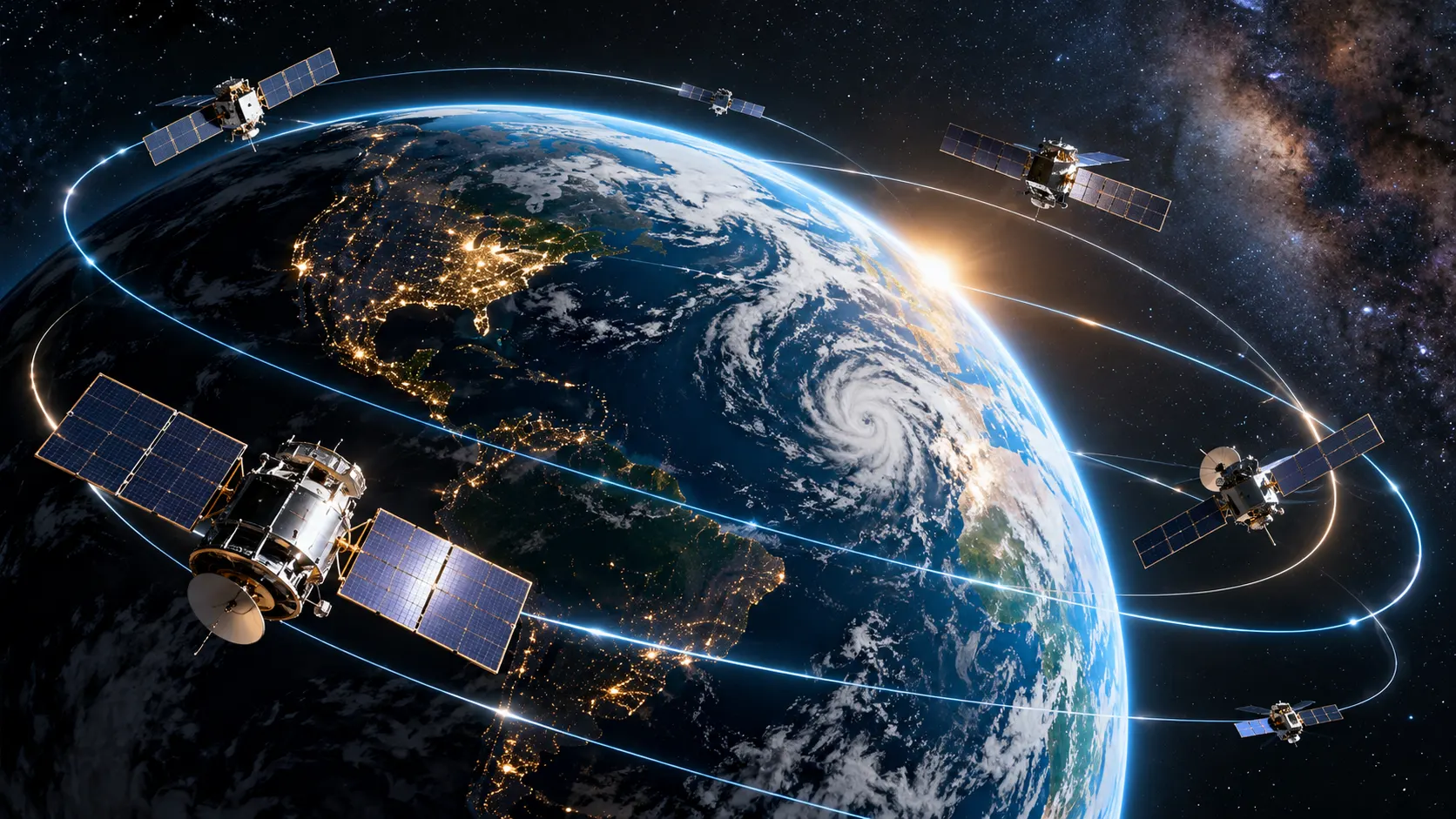
Satellites play an important role in modern life, supporting communication, weather forecasting, navigation, scientific research, and global technology. Thousands of artificial satellites travel around Earth every day, often moving at incredible speeds high above the planet. Although these objects appear to float effortlessly through space, their movement depends on powerful natural forces and carefully calculated orbital paths.
Understanding how satellites stay in orbit around planet Earth helps explain the relationship between gravity, speed, and motion in space. Satellites do not remain above Earth because gravity disappears or because engines continuously push them forward. Instead, they follow specific paths created by the balance between gravitational attraction and their sideways motion.
1. What Is a Satellite and How Does Orbit Work?
A satellite is an object that travels around a larger body because of gravitational attraction. Natural satellites, such as the Moon, orbit planets, while artificial satellites are machines launched into space for specific purposes. These spacecraft follow orbital paths that allow them to remain above Earth’s surface while continuously moving around the planet.
An orbit is the curved path an object follows under the influence of gravity. When a satellite travels fast enough in the appropriate direction, Earth’s gravity continually changes its path without immediately pulling it into the ground. This creates continuous orbital motion that can continue for extended periods under suitable conditions.
Satellites can follow circular or elliptical orbits depending on their speed, position, and mission requirements. Circular orbits maintain approximately the same altitude, while elliptical paths move closer to and farther from Earth. Engineers carefully calculate these orbital characteristics to ensure satellites perform their intended functions while maintaining predictable movement around the planet.
2. How Earth’s Gravity Keeps Satellites in Orbit
Gravity is the primary force responsible for keeping satellites in orbit around Earth. Every object with mass attracts other objects, and Earth’s enormous mass creates a gravitational field extending far into space. Although gravitational attraction becomes weaker with increasing distance, it remains strong enough to influence satellites traveling thousands of kilometers above the surface.
Without gravity, a satellite would continue moving in a straight line rather than following a curved path around Earth. Gravity continuously pulls the satellite toward the planet, changing the direction of its movement. This inward acceleration allows the spacecraft to follow an orbital trajectory instead of traveling endlessly in one straight direction.
The same gravitational principle explains why the Moon travels around Earth and why planets orbit the Sun. Satellites follow similar physical laws despite being much smaller than natural celestial bodies. Understanding gravity is therefore essential for predicting orbital motion, calculating satellite positions, and designing successful space missions.
3. Why Satellites Need High Speed to Stay in Orbit
Satellites require considerable sideways speed because gravity continuously pulls them toward Earth. If a spacecraft moved too slowly at a particular altitude, its trajectory could intersect the atmosphere or the planet’s surface. Sufficient horizontal velocity allows the satellite to keep moving forward while gravity gradually curves its path around Earth.
Imagine throwing a ball horizontally from a very high location. The ball moves forward while gravity pulls it downward, eventually causing it to reach the ground. If it could travel fast enough without encountering air resistance or obstacles, Earth’s curved surface would fall away beneath its path as it continued moving.
This idea helps explain why satellites are often described as continuously falling around Earth. They experience gravitational acceleration but move sideways fast enough to keep missing the planet. Their orbital motion results from this combination of forward velocity and gravitational attraction rather than an ongoing upward force holding them in space.
4. How Fast Do Satellites Travel Around Earth?
Satellite speed depends on orbital altitude and the shape of the orbital path. Spacecraft traveling in low Earth orbit typically move at approximately 7.8 kilometers per second, although exact speeds vary with altitude. This extraordinary velocity allows them to complete an orbit in roughly 90 minutes when operating at altitudes similar to the International Space Station.
Satellites farther from Earth generally travel at lower orbital speeds because gravitational attraction decreases with distance. For example, satellites in geostationary orbit move much more slowly than spacecraft in low Earth orbit. However, their larger orbital paths mean they take approximately one sidereal day to complete a revolution around the planet.
Orbital speed is not the same for every satellite because different missions require different trajectories. Satellites following elliptical orbits move faster when closer to Earth and slower when farther away. Engineers use orbital mechanics to calculate suitable velocities, ensuring spacecraft reach their intended destinations and remain on predictable paths.
5. How Rockets Launch Satellites Into Orbit
Satellites begin their journeys aboard powerful rockets designed to overcome Earth’s gravitational attraction and atmospheric resistance. The rocket provides the energy needed to lift the spacecraft from the launchpad and accelerate it toward orbital speed. Reaching a suitable altitude alone is not enough because the satellite must also gain sufficient sideways velocity.
During launch, rockets initially climb through the lower atmosphere before gradually turning toward a more horizontal flight direction. This maneuver helps build the velocity required for orbital motion while continuing to increase altitude. Rocket stages may separate during the journey, allowing the remaining vehicle to accelerate more efficiently as unnecessary mass is discarded.
Once the spacecraft reaches the appropriate orbital conditions, it separates from the launch vehicle and begins operating independently. Some satellites require additional engine firings to reach their final operational orbits. Engineers monitor position, speed, and orientation throughout this process to ensure the spacecraft enters a suitable and stable orbital trajectory.
6. Different Types of Satellite Orbits Around Earth
Satellites operate at different altitudes depending on their intended purposes and technical requirements. Low Earth orbit generally extends from a few hundred kilometers to approximately 2,000 kilometers above the planet. This region supports many Earth observation satellites, research spacecraft, and communication systems that benefit from relatively short distances to the surface.
Medium Earth orbit lies above low Earth orbit and below the geosynchronous orbital region. Navigation systems such as GPS use medium Earth orbits because their satellites can cover large areas while maintaining suitable positioning accuracy. These spacecraft usually take several hours to complete one revolution rather than circling Earth approximately every 90 minutes.
Geostationary orbit is located approximately 35,786 kilometers above Earth’s equator. A satellite in this circular, equatorial orbit moves in the same direction as Earth’s rotation and appears stationary over one geographic location. This makes geostationary satellites particularly useful for certain communications and weather-monitoring services requiring continuous coverage of specific regions.
7. Why Astronauts and Satellites Experience Weightlessness
Satellites and astronauts in orbit experience conditions commonly described as weightlessness or microgravity. However, this does not mean Earth’s gravitational force has disappeared. Gravity remains substantial at the altitudes used by many spacecraft, including the International Space Station, which operates only a few hundred kilometers above Earth’s surface.
The sensation of weightlessness occurs because astronauts and their spacecraft are falling freely together around the planet. Both experience nearly the same gravitational acceleration, so astronauts do not feel the usual supporting force from a floor. As a result, objects can appear to float inside the spacecraft while the entire structure follows its orbital path.
Scientists use microgravity environments to study physical processes that behave differently when ordinary weight-related effects are greatly reduced. Experiments may investigate fluids, materials, biological systems, and other scientific subjects. Understanding orbital weightlessness helps explain why astronauts float even though Earth’s gravity continues influencing their movement throughout every orbit.
8. Do Satellites Need Engines to Remain in Orbit?
One common misunderstanding is that satellites must continuously operate their engines to avoid falling toward Earth. In reality, a spacecraft in a suitable orbit can continue moving without constant propulsion. Once the required orbital velocity has been established, gravity changes its direction of travel while inertia allows it to maintain motion.
In an ideal environment without atmospheric drag or other disturbances, a satellite could follow a stable orbit without repeatedly using fuel. Real orbital environments are more complicated because satellites experience additional influences, including uneven gravitational fields and attraction from other celestial bodies. These effects can gradually change orbital characteristics and require occasional corrections.
Satellite engines and thrusters are therefore generally used for specific maneuvers rather than continuously maintaining forward movement. Spacecraft may adjust their altitude, orientation, or position to meet mission requirements. Understanding this distinction explains how satellites can remain operational for years even though their onboard fuel supplies are limited.
9. How Earth’s Atmosphere Affects Satellite Orbits
Although space contains very little matter compared with Earth’s lower atmosphere, traces of atmospheric gases remain at many satellite altitudes. Spacecraft traveling through these particles experience a small amount of aerodynamic resistance called atmospheric drag. Over time, this resistance reduces orbital energy and can cause satellites to descend toward lower altitudes.
Atmospheric drag is particularly important for satellites operating in low Earth orbit. Its strength depends on altitude, spacecraft shape, atmospheric density, and solar activity. When the upper atmosphere expands during periods of increased solar activity, satellites may experience stronger drag and lose altitude more quickly than expected.
Engineers account for atmospheric drag when selecting orbital altitudes and planning spacecraft lifetimes. Some satellites periodically increase their altitude to compensate for gradual orbital decay. Others are designed to descend naturally after completing their missions, eventually entering denser atmospheric layers where heating and aerodynamic forces can destroy much of the spacecraft.
10. How Satellites Adjust Their Orbits and Positions
Satellites sometimes need orbital adjustments to maintain their intended operational paths or avoid undesirable changes. These maneuvers are commonly called station-keeping when they maintain a spacecraft within required orbital limits. Small thrusters or other propulsion systems provide controlled changes in velocity that gradually alter the satellite’s orbit.
Geostationary satellites require periodic corrections because gravitational influences from the Moon, Sun, and Earth’s irregular gravitational field can disturb their positions. Without adjustments, they may drift away from their assigned operating regions. Satellite operators monitor these changes and use carefully planned maneuvers to maintain appropriate coverage and coordination with nearby spacecraft.
Some modern satellites use electric propulsion systems that generate relatively small thrust over longer periods. Other spacecraft employ chemical propulsion for maneuvers requiring different performance characteristics. The selected technology depends on spacecraft mass, fuel availability, mission duration, and orbital requirements, making propulsion planning an important part of satellite engineering.
11. How Satellites Avoid Collisions and Space Debris
Earth’s orbital environment contains operational satellites, inactive spacecraft, discarded rocket components, and fragments of space debris. These objects can travel at extremely high relative speeds, making collisions potentially damaging even when the objects involved are small. Satellite operators therefore monitor orbital traffic and assess possible close approaches between spacecraft and tracked debris.
Ground-based radar systems and telescopes help track many objects traveling around Earth. Orbital data allows specialists to estimate future positions and identify situations where two objects may pass dangerously close together. Because measurements contain uncertainty, operators must evaluate collision probabilities carefully before deciding whether a spacecraft requires an avoidance maneuver.
Satellites equipped with suitable propulsion systems can sometimes adjust their paths to reduce collision risks. However, not every spacecraft can maneuver, and many small debris fragments remain difficult to track. Responsible mission planning, spacecraft disposal, and international cooperation are important for reducing orbital hazards and preserving access to space for future activities.
12. How Long Can Satellites Stay in Orbit?
The length of time a satellite remains in orbit depends on its altitude, design, and surrounding environmental conditions. Spacecraft in very low orbits may experience enough atmospheric drag to descend relatively quickly. Satellites operating at higher altitudes can remain in space for decades or longer because atmospheric resistance becomes significantly weaker.
Operational lifetime is different from orbital lifetime because a satellite may stop functioning while continuing to travel around Earth. Electronic systems, batteries, propulsion equipment, and other components can eventually reach the end of their useful lives. Once a satellite becomes inactive, its orbital path may persist even though it no longer performs its original mission.
Responsible satellite disposal helps reduce long-term risks to other spacecraft and future missions. Some satellites are directed into lower orbits so they eventually reenter Earth’s atmosphere, while others move into designated disposal orbits. These decisions depend on altitude, available propulsion, applicable requirements, and the spacecraft’s ability to perform safe end-of-mission maneuvers.
Conclusion
Satellites remain in orbit around Earth because gravity and sideways velocity work together to produce continuous curved motion. Earth’s gravitational attraction pulls satellites inward, while their forward movement allows them to keep traveling around the planet instead of immediately reaching the ground. This natural relationship makes orbital motion possible without requiring engines to operate continuously.
Different satellite missions require carefully selected altitudes, speeds, and orbital paths. Rockets provide the initial energy necessary to reach orbit, while occasional propulsion maneuvers help maintain suitable operating conditions. Factors such as atmospheric drag, gravitational disturbances, and space debris can influence satellite movement, making accurate calculations and ongoing monitoring essential for successful space operations.
Understanding how satellites stay in orbit reveals the remarkable scientific principles behind technologies used in everyday life. From global navigation and weather observation to scientific research and communication, orbiting spacecraft provide services that depend on predictable movement around Earth. By applying the laws of gravity and motion, engineers can design satellites capable of operating reliably in space for many years.
Frequently Asked Questions (FAQs)
1. Why don’t satellites fall back to Earth?
Satellites remain in orbit because their sideways velocity allows them to continuously fall around Earth instead of directly reaching the ground. Gravity curves their paths while their forward motion keeps them moving.
2. How fast do satellites travel around Earth?
Satellites in low Earth orbit commonly travel at approximately 7.8 kilometers per second. Their exact speed depends on orbital altitude and trajectory, with higher circular orbits generally requiring lower orbital speeds.
3. Do satellites use fuel to stay in orbit?
Satellites do not require continuous fuel consumption to maintain orbital motion. However, some use onboard propulsion to correct orbital changes, maintain assigned positions, or perform collision avoidance and disposal maneuvers.
4. How high above Earth do satellites orbit?
Satellites operate at different altitudes depending on their missions. Low Earth orbit generally extends up to about 2,000 kilometers, while geostationary satellites operate approximately 35,786 kilometers above Earth’s equator.
5. What happens when a satellite stops working?
An inactive satellite may remain in orbit after its mission ends. Depending on altitude and disposal planning, it may eventually reenter Earth’s atmosphere or remain in a higher disposal orbit for an extended period.