

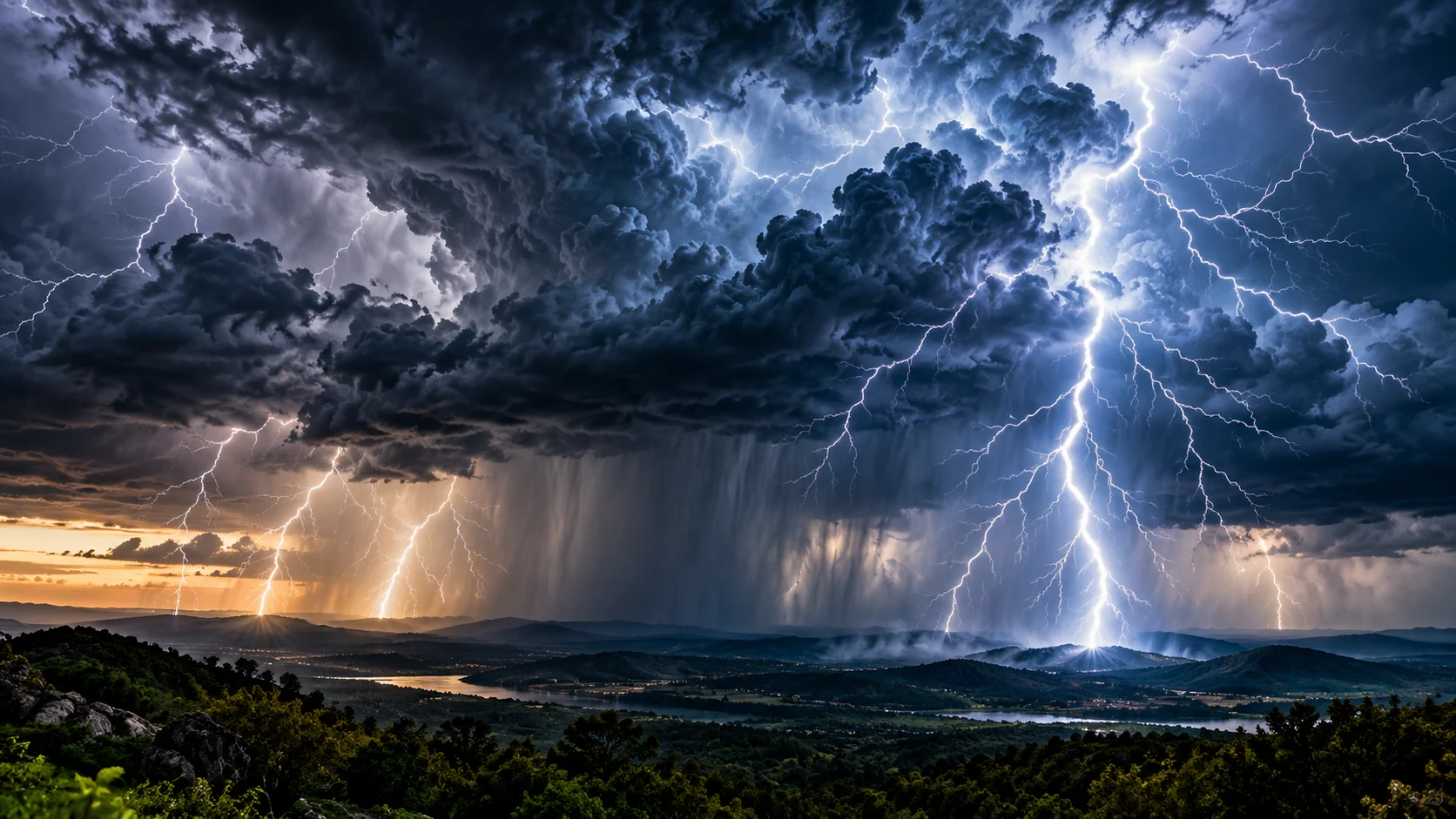
What Happens Inside a Powerful Thunderstorm?
Powerful thunderstorms develop when warm, moist air rises rapidly into cooler parts of the atmosphere. As this air rises, water vapor condenses into clouds and releases heat, helping the storm grow taller and stronger. Large thunderstorm clouds, called cumulonimbus clouds, can extend many kilometers upward and contain intense winds, rain, ice particles, and rapidly moving electrical charges.
Inside these towering clouds, powerful updrafts carry water droplets and small ice crystals upward while heavier particles fall toward the ground. These movements create constant collisions between ice, water, and hail-like particles known as graupel. The turbulent environment provides the conditions needed for electrical charges to separate and eventually produce the dramatic lightning flashes associated with severe weather.
Thunderstorms can vary greatly in strength, but the most powerful systems often contain extremely strong vertical air currents. These storms may produce heavy rainfall, damaging winds, hail, frequent lightning, and sometimes tornadoes. Lightning and thunder are closely connected to the electrical activity occurring inside the storm, making them some of the clearest signs that a thunderstorm has become highly energetic.
How Does Electrical Charge Build Inside Storm Clouds?
Electrical charge develops inside storm clouds through repeated collisions between ice crystals, supercooled water droplets, and graupel. These particles move at different speeds and directions because strong updrafts and downdrafts constantly circulate air within the cloud. During collisions, electrical charges can transfer between particles, gradually separating positive and negative charges into different regions of the thunderstorm.
In many thunderstorms, lighter positively charged ice crystals are carried toward the upper portion of the cloud. Heavier graupel particles often develop a negative charge and remain in the middle or lower sections. This separation creates a large electrical imbalance, similar in principle to static electricity, although the electrical forces inside powerful storms can become enormously more intense.
As the charge separation increases, an electrical field develops between different parts of the cloud and between the cloud and the ground. Eventually, the electrical difference becomes strong enough to overcome the insulating properties of the surrounding air. When that happens, electricity suddenly moves through the atmosphere, producing the brilliant discharge that we recognize as lightning.
What Actually Causes a Lightning Bolt?
A lightning bolt forms when the electrical field inside or around a thunderstorm becomes strong enough to ionize the air. Normally, air does not conduct electricity very easily, which allows large electrical charges to accumulate. Once the electrical difference reaches a critical point, however, charged particles begin creating a conductive pathway through the atmosphere.
For cloud-to-ground lightning, a faint channel of negative charge may travel downward from the cloud in a series of short steps. At the same time, positively charged streamers can rise from buildings, trees, poles, and the ground. When these electrical pathways connect, a powerful electrical current rapidly travels through the channel and produces an extremely bright lightning flash.
The visible flash may appear instantaneous, but lightning often contains several rapid electrical pulses occurring within a fraction of a second. This repeated activity is why some lightning bolts seem to flicker. The electrical discharge heats the surrounding air dramatically, creating both the brilliant light we see and the sudden atmospheric expansion that ultimately produces thunder.
Why Does Lightning Look So Bright?
Lightning appears extremely bright because enormous amounts of electrical energy move through a narrow pathway in a very short period. The electrical current rapidly heats the air within the lightning channel to exceptionally high temperatures. This intensely heated air becomes ionized and emits visible light, creating the brilliant white, blue, or purple flashes commonly seen during thunderstorms.
A lightning channel can briefly become hotter than the surface of the Sun, although it remains hot for only a very short time. The intense heat causes atoms and molecules in the surrounding air to become highly energized. As they release energy, they produce light across different wavelengths, contributing to the distinctive brightness and color of lightning.
The exact appearance of lightning can also depend on atmospheric conditions and viewing distance. Rain, dust, cloud cover, and moisture can scatter the light and make a flash appear different in color or intensity. Lightning hidden within clouds may illuminate an entire section of the sky, while nearby cloud-to-ground bolts can appear sharply defined and exceptionally bright.
What Causes Thunder After Lightning?
Thunder is caused by the extremely rapid expansion of air surrounding a lightning channel. When lightning passes through the atmosphere, it heats nearby air almost instantly to very high temperatures. The heated air expands explosively, creating a pressure wave that travels outward through the atmosphere and reaches our ears as the sound known as thunder.
The pressure wave initially behaves like a powerful shock wave because the air expands so quickly. As it travels farther away from the lightning channel, the wave gradually weakens and becomes an ordinary sound wave. The distance, shape, and orientation of the lightning bolt influence whether the thunder sounds like a sharp crack, deep boom, or long rolling rumble.
Nearby lightning often produces a sudden explosive clap because the sound reaches the observer quickly and with relatively little weakening. More distant lightning usually creates softer, longer thunder because sound from different sections of the bolt arrives at slightly different times. Hills, buildings, clouds, and atmospheric conditions can also reflect or distort sound, making thunder seem to echo.
Why Do We See Lightning Before Hearing Thunder?
Light travels much faster than sound, which is why lightning is seen before thunder is heard. The light from a lightning bolt reaches our eyes almost immediately, even when the storm is several kilometers away. Sound moves much more slowly through the atmosphere, so the pressure waves responsible for thunder require additional time to travel the same distance.
This difference between light and sound can help estimate how far away a lightning strike occurred. After seeing a flash, counting the seconds until thunder is heard provides a rough indication of distance. A longer delay usually means the lightning occurred farther away, while thunder that follows almost immediately suggests the strike happened dangerously close.
Although distant lightning may appear harmless, any thunder indicates that lightning is occurring close enough to potentially pose a risk. Storms can produce strikes several kilometers away from the heaviest rainfall or darkest clouds. For this reason, hearing thunder should be treated as a warning that dangerous electrical activity may be occurring within the surrounding area.
What Are the Main Types of Lightning?
Cloud-to-ground lightning is one of the most familiar types because it creates a visible connection between a storm cloud and Earth’s surface. These strikes can hit trees, buildings, power lines, open land, and people. Although visually dramatic, cloud-to-ground flashes represent only part of the electrical activity occurring during a typical thunderstorm.
Intracloud lightning occurs entirely within a single storm cloud and is extremely common. Electrical discharges travel between differently charged regions inside the cloud, producing bright flashes that may illuminate large areas of the sky. When clouds hide the actual electrical channel, observers may see widespread glowing light sometimes described informally as sheet lightning.
Cloud-to-cloud lightning travels between separate storm clouds, while other rarer forms of electrical activity can occur above thunderstorms. Lightning may also have different electrical polarities depending on where the charge originates. Positive cloud-to-ground lightning is less common than negative lightning but can involve powerful electrical currents and may strike farther away from the storm’s main rainfall area.
Why Are Some Storms More Electrically Active?
The amount of lightning produced by a storm depends strongly on its internal structure and atmospheric conditions. Storms with powerful updrafts can carry large quantities of water and ice through different temperature zones. This creates frequent collisions among particles, increasing charge separation and allowing stronger electrical fields to develop within the cloud.
Ice plays an especially important role in thunderstorm electrification. Storms that contain large mixed regions of ice crystals, supercooled water, and graupel often generate significant electrical activity. Strong vertical winds repeatedly move these particles through the cloud, creating an environment where electrical charge can accumulate more efficiently and lead to frequent lightning discharges.
Temperature, humidity, instability, and wind patterns can also affect storm intensity. Warm, moisture-rich air near the surface provides energy that allows thunderstorms to grow vertically. When atmospheric conditions strongly support rising air, storms may become exceptionally tall and powerful, increasing the chances of heavy rainfall, hail, severe winds, and intense lightning activity.
Why Does Thunder Sometimes Rumble for Several Seconds?
A lightning bolt may stretch across several kilometers and contain numerous branches rather than forming one simple straight channel. Sound from the nearest part of the bolt reaches an observer first, while sound from more distant sections arrives slightly later. This difference in arrival time creates the long rolling or rumbling sound often heard after distant lightning.
The atmosphere also affects how thunder travels. Variations in temperature, wind speed, humidity, and air density can bend sound waves or cause them to travel differently at various heights. These conditions may strengthen certain parts of the sound while weakening others, contributing to the changing volume and pitch that make thunder seem to roll across the sky.
Surrounding terrain can further influence the sound of thunder. Mountains, valleys, buildings, and other large surfaces can reflect sound waves and produce echoes. When several reflected waves reach an observer at different times, thunder can continue for several seconds even though the actual lightning discharge lasted only a small fraction of that period.
Can Lightning Strike Without Heavy Rain?
Lightning can occur even when little or no rain is falling at a person’s location. Thunderstorms may extend across large areas, while electrical discharges can travel far beyond the region experiencing the heaviest rainfall. A person may therefore see blue sky or light cloud cover overhead while dangerous lightning occurs from a nearby storm system.
Some cloud-to-ground lightning strikes extend horizontally from the side of a thunderstorm before turning toward the surface. These bolts may reach locations several kilometers away from the storm’s main cloud base. Because the strike can appear to come from a relatively clear area, such events are sometimes unexpectedly dangerous to people who believe the storm has already passed.
Dry thunderstorms can also produce lightning while much of their rainfall evaporates before reaching the surface. These conditions are particularly important in dry landscapes because lightning can ignite vegetation and contribute to wildfires. Even without heavy rain, the electrical activity inside the cloud can remain strong enough to generate frequent and powerful lightning strikes.
Why Does Lightning Strike Tall Objects?
Lightning does not simply target the tallest object in every situation, but height can influence where electrical connections develop. Tall structures reduce the distance between the ground and electrically charged regions of a storm. During a developing strike, upward electrical streamers may form from trees, buildings, towers, poles, and other elevated objects.
A lightning strike ultimately follows a conductive pathway that successfully connects electrical charges between different regions. Tall objects can increase the likelihood of this connection because their upper surfaces are closer to the descending electrical channel. However, lightning can also strike open ground, shorter buildings, vehicles, and other objects, so being away from tall structures does not guarantee safety.
The shape and electrical characteristics of an object may also affect local electric fields. Sharp or elevated points can concentrate electrical charge, encouraging upward streamers during certain conditions. This principle helps explain why lightning protection systems use strategically positioned conductive rods and pathways designed to safely direct electrical current toward the ground.
How Dangerous Are Lightning and Thunderstorms?
Lightning is one of the most dangerous natural hazards associated with thunderstorms because electrical currents can cause severe injury, fires, and damage to electrical systems. A direct strike can be extremely dangerous, but people may also be affected through nearby ground currents or electricity traveling through conductive materials. Storm safety should therefore be taken seriously whenever thunder is heard.
The safest protection during a thunderstorm is generally inside a substantial enclosed building or a fully enclosed vehicle. Open fields, hilltops, isolated trees, beaches, water, and exposed outdoor structures provide poor protection from lightning. People should avoid unnecessary contact with electrical equipment, plumbing, and other conductive systems when strong electrical activity is occurring nearby.
Lightning is not the only hazard associated with powerful thunderstorms. Strong winds, flooding, hail, falling trees, and tornadoes can also develop depending on atmospheric conditions. Recognizing darkening skies, increasing winds, frequent lightning, and approaching thunder can provide useful warning that conditions are becoming dangerous and that shelter should be sought promptly.
Conclusion
Lightning and thunder are produced by powerful electrical and atmospheric processes occurring inside thunderstorms. Strong updrafts and downdrafts cause ice particles, water droplets, and graupel to collide, allowing positive and negative charges to separate. When the electrical difference becomes strong enough, electricity moves through the atmosphere and creates a brilliant lightning discharge.
Thunder develops because lightning heats the surrounding air extremely rapidly. The air suddenly expands and produces pressure waves that travel outward as sound. Because light travels far faster than sound, we see the lightning flash before hearing the thunder, while the shape and distance of the lightning channel determine whether thunder sounds like a sharp crack or extended rumble.
Understanding what causes lightning and thunder makes powerful storms easier to understand and respect. These events demonstrate how heat, moisture, wind, ice, electricity, and atmospheric pressure interact during severe weather. Although lightning can be visually impressive, every thunderstorm containing electrical activity should be treated carefully because dangerous strikes can occur beyond the area of heavy rain.
Frequently Asked Questions
What causes lightning during a thunderstorm?
Lightning occurs when collisions between ice, water droplets, and graupel separate electrical charges inside a storm cloud. When the electrical difference becomes strong enough, a sudden electrical discharge travels through the atmosphere.
Why does thunder happen after lightning?
Lightning heats the surrounding air extremely quickly, causing it to expand explosively. This rapid expansion creates pressure waves that travel through the atmosphere as sound, producing the thunder heard after a lightning flash.
Can lightning happen without thunder?
Lightning always creates thunder, but you may not always hear it. If the lightning occurs far enough away, the sound waves can weaken before reaching you even though the flash remains visible.
Why does thunder sometimes sound like a loud crack?
A sharp crack usually occurs when lightning strikes relatively close to the observer. Sound from nearby sections of the lightning channel arrives almost simultaneously, creating a sudden and powerful burst of thunder.
Can lightning strike the same place more than once?
Yes, lightning can strike the same location repeatedly, especially tall structures that frequently provide favorable electrical pathways. Towers, skyscrapers, and other elevated objects may experience multiple lightning strikes during different storms.