

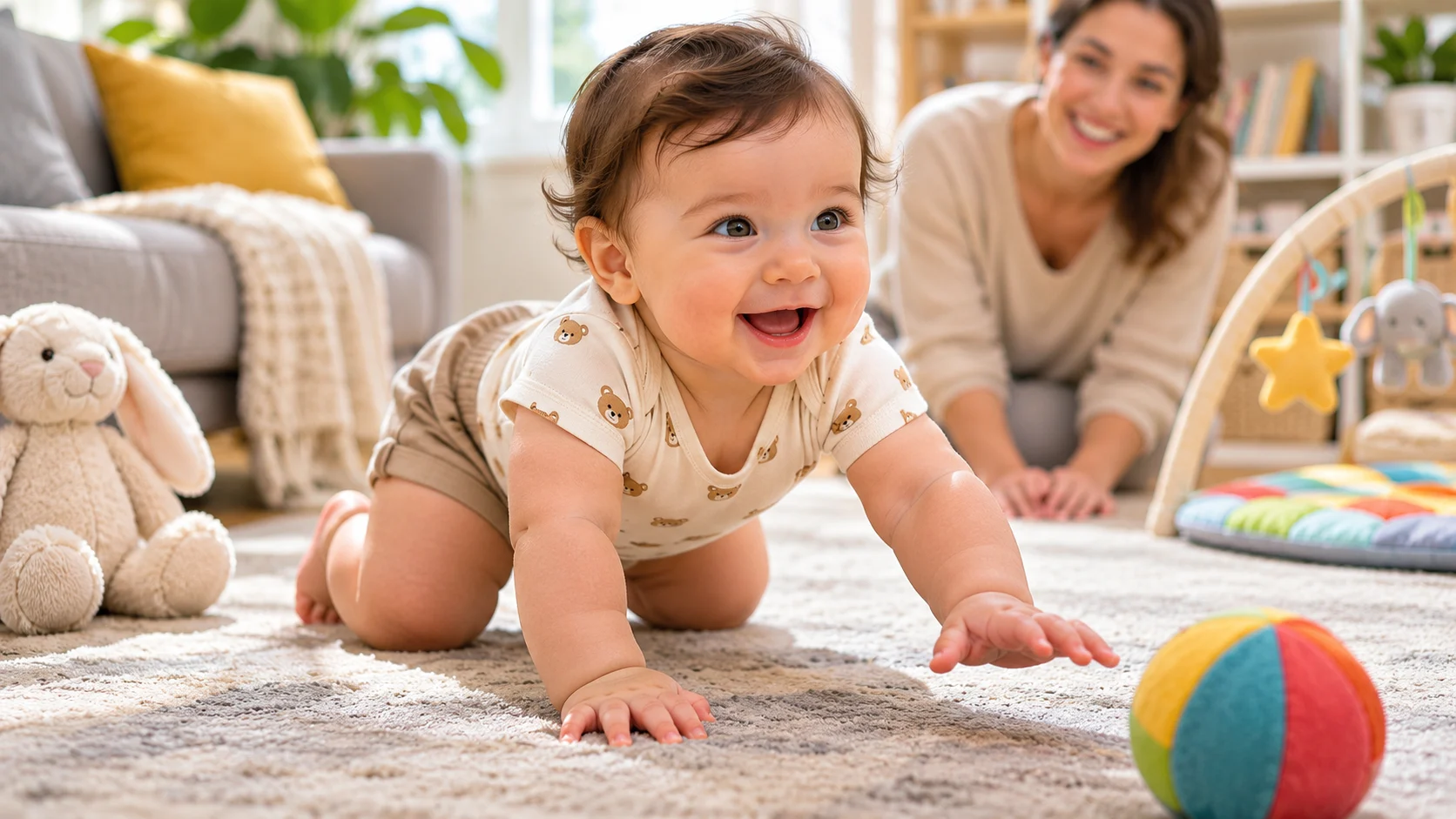
Watching a baby grow and reach new milestones is one of the most exciting parts of parenting. From lifting their head to rolling over and sitting independently, every new movement shows how their strength and coordination are developing. One milestone that many parents eagerly anticipate is crawling, which helps babies begin exploring their surroundings independently.
So, when do babies start crawling? Most babies who crawl begin between 7 and 10 months of age, although some start earlier or later. Every baby develops at a different pace, and some skip traditional crawling altogether before learning to walk. Understanding these differences can help parents support their child’s development without unnecessary comparisons.
Crawling involves several physical skills, including balance, muscle strength, coordination, and body awareness. Babies often practice different movements before they begin moving confidently across the floor. This guide explains typical crawling ages, early signs, different crawling styles, ways to encourage movement, and when developmental concerns deserve professional attention.
When Do Babies Start Crawling?
Most babies begin crawling between 7 and 10 months, although the timing varies considerably. Some develop independent movement around 6 months, while others take longer to coordinate their arms and legs. Crawling is not a universal developmental milestone, so reaching it at a particular age is not necessary for every child.
Parents often wonder when do babies start crawling on average, especially when comparing their child’s progress with typical development. Although many babies start around 8 or 9 months, there is no single age that applies to everyone. Some babies move by rolling, scooting, or sliding before developing a traditional crawling pattern.
A baby’s crawling timeline depends on individual physical development and opportunities for movement. Strength, coordination, motivation, and experience playing on the floor can all influence progress. Rather than focusing only on age, observe whether your baby is gradually developing new movement skills and exploring their environment.
Early Signs Your Baby Is Getting Ready to Crawl
Babies often demonstrate several early signs before learning to crawl independently. They may lift their chest during tummy time, push against the floor, or reach for nearby toys. These actions help strengthen muscles in the shoulders, arms, back, and abdomen that support future movement.
Another common sign is rocking forward and backward while positioned on hands and knees. Babies may also push themselves backward before discovering how to move forward. These movements show growing coordination, even when the baby has not yet learned how to travel across the room.
Some babies rotate in circles on their stomachs or repeatedly shift their weight from one side to another. Others attempt to reach toys placed slightly beyond their normal reach. These behaviors are useful opportunities for exploration, but their absence does not automatically indicate a developmental problem.
When Do Babies Start Crawling and Sitting Up?
Many parents ask when do babies start crawling and sitting up because these abilities develop during the same general period. Babies usually gain the ability to sit before they begin traditional crawling. Sitting independently helps develop balance, trunk control, and the coordination needed for more complex movement.
Many babies can sit without support around 6 to 9 months, although developmental timing varies. The Centers for Disease Control and Prevention lists sitting without support among its 9-month developmental milestones. Babies may begin practicing crawling movements before or after becoming comfortable in a seated position.
Sitting and crawling develop through repeated movement and opportunities to explore. A baby may learn to move from sitting onto their stomach or hands and knees while reaching for a toy. Providing supervised floor play allows these transitions to develop naturally without forcing the baby into positions they cannot manage.
When Do Babies Start Crawling After Rolling?
Rolling is one of the earlier movement skills that babies commonly develop before crawling. Many babies begin rolling during the first several months, although the timing differs between individuals. Rolling helps develop body awareness and coordination as babies learn how to shift their weight.
Parents sometimes ask when do babies start crawling after rolling, expecting a predictable gap between these milestones. However, there is no fixed number of weeks or months separating them. Some babies spend considerable time rolling and pivoting before beginning to crawl, while others develop different ways of moving.
Once babies become comfortable rolling, they may experiment with pushing themselves across the floor. Some use their arms to pull forward, while others move backward or turn toward interesting objects. These movements are part of learning to explore, and each baby may follow a different developmental sequence.
When Do Babies Start Crawling on Hands and Knees?
Traditional crawling involves moving forward with the hands and knees supporting the body. Parents wondering when do babies start crawling on hands and knees will often see this pattern emerge around 7 to 10 months. However, some babies never use this style and instead explore through other movement patterns.
Another common question is when do babies start crawling on knees rather than sliding along their stomachs. Some babies begin with belly crawling before lifting their abdomen away from the floor. Others transition directly into hands-and-knees crawling after practicing rocking and weight shifting.
The timing of these changes depends on coordination and muscle development. Babies need to alternate movements between their arms and legs while maintaining balance. Supervised play on a firm, safe floor provides opportunities to practice these abilities without requiring parents to teach a specific crawling technique.
When Do Babies Start Crawling on All Fours?
Parents frequently wonder when do babies start crawling on all fours after noticing their child pushing upward during play. This position usually involves supporting the body on both hands and knees. Some babies begin rocking in this position before developing the coordination needed to move forward.
Hands-and-knees positioning requires strength in the shoulders, arms, hips, and trunk. Babies gradually develop these abilities while reaching, pushing, rolling, and changing positions. Repeated movement helps them become comfortable transferring their weight between different parts of the body.
Not every baby spends a long period rocking on all fours before crawling. Some begin moving almost immediately, while others return to belly crawling or scooting. These differences are generally part of normal developmental variation, although persistent concerns about movement should be discussed with a pediatrician.
Different Types of Baby Crawling
Babies can move across the floor in several ways before walking. Traditional crawling is only one example, and alternative movement patterns are common. Understanding different crawling styles helps parents recognize their baby’s progress even when their movements do not resemble the familiar hands-and-knees position.
Belly crawling, sometimes called commando crawling, involves pulling the body forward while keeping the stomach near the floor. Some babies use bottom scooting, moving while sitting upright. Others adopt bear crawling, where the hands and feet support the body while the knees remain lifted.
Some babies also roll repeatedly to reach toys or move through a combination of different techniques. There is no requirement that every child must experience all crawling styles. What matters is continued development, increasing independence, and the ability to explore the environment safely.
When Do Babies Start Crawling on Their Own?
Parents often ask when do babies start crawling on their own rather than relying on help or encouragement. Many babies begin independently exploring the floor during the second half of their first year. The exact timing varies depending on their individual development and preferred movement patterns.
Before moving independently, babies may practice pushing, rocking, turning, and reaching. These activities help them discover how different movements affect their position. Some babies appear hesitant initially but become more confident as they gain experience and learn to control their bodies.
Parents can support independent movement by providing safe opportunities to play on the floor. Place interesting toys nearby and allow the baby to decide how to approach them. Avoid pulling their limbs or forcing them forward, since crawling skills should develop through comfortable, self-directed movement.
When Do Babies Start Crawling Up Stairs?
Learning to crawl on a flat surface is different from navigating stairs. Parents wondering when do babies start crawling up stairs should understand that this ability usually develops after a baby has gained some experience moving independently. There is no standard age at which babies should climb stairs.
Some mobile babies become interested in stairs during the later months of their first year. However, curiosity does not mean they understand the risks involved. Babies may attempt to climb upward before developing the judgment, coordination, or ability to descend safely.
Stair safety requires constant attention because falls can cause serious injuries. Install appropriate safety gates at both the top and bottom of stairways, following manufacturer instructions. Never allow a baby to explore stairs unsupervised, even if they appear confident while crawling on ordinary floors.
When Do Babies Start Crawling and Walking?
Many parents ask when do babies start crawling and walking because these milestones are closely associated with early mobility. Crawling commonly develops during the second half of the first year, while independent walking often begins around 12 to 18 months. However, the developmental sequence and timing differ between children.
Some babies crawl for several months before taking their first independent steps. Others move through rolling, scooting, pulling to stand, and cruising along furniture without traditional crawling. The CDC includes taking a few independent steps among its 15-month milestones and walking without holding on among its 18-month milestones.
Walking requires additional balance, coordination, and strength compared with many crawling movements. Babies generally practice standing and moving along furniture before walking independently. Providing safe opportunities for exploration helps support these transitions without pressuring children to achieve milestones before they are ready.
How to Encourage Your Baby to Crawl
Supervised tummy time is one of the most useful activities for supporting early motor development. It gives babies opportunities to lift their heads, strengthen upper-body muscles, and explore movement. Begin with short, comfortable sessions while the baby is awake and gradually increase the duration as tolerated.
Placing colorful toys slightly beyond your baby’s reach can encourage stretching, turning, and attempts to move forward. Choose age-appropriate objects without small detachable pieces or other choking hazards. The goal is to make exploration enjoyable rather than creating pressure to reach a particular milestone.
Parents can also encourage movement by spending time interacting with their baby on the floor. Talking, smiling, and offering interesting toys may motivate the child to explore. Avoid wheeled baby walkers, which create injury risks and do not help babies learn to walk safely.
How to Create a Safe Crawling Environment
Once babies become mobile, their surroundings require additional safety precautions. Objects that were previously out of reach may suddenly become accessible. Parents should examine the home from floor level to identify potential hazards before their baby begins moving independently.
Secure heavy furniture and televisions to prevent tipping, cover accessible electrical outlets, and keep small objects away from the floor. Cleaning products, medications, cords, and sharp items should remain inaccessible. Safety gates are especially important near stairways and other potentially dangerous areas.
Provide a clean, firm surface where your baby can practice movement under adult supervision. Avoid placing babies on elevated surfaces where they could fall unexpectedly. A safe environment allows children to explore their developing abilities while reducing preventable injuries and unnecessary restrictions.
Do All Babies Crawl Before Walking?
Not all babies crawl before learning to walk, and this variation can be completely normal. Some children move directly from sitting or scooting to pulling themselves upright and cruising. Others use rolling or belly movement without ever developing a traditional hands-and-knees crawling pattern.
Crawling is not included as a required milestone in the CDC’s current developmental milestone checklists. Pediatric professionals consider a broader range of movement abilities when assessing development. A child who skips crawling may still progress normally through standing, cruising, and independent walking.
However, differences in movement should not automatically be dismissed simply because crawling is optional. Difficulty using one side of the body, persistent stiffness, unusual weakness, or loss of previously developed skills deserves professional evaluation. A pediatrician can assess the overall developmental picture rather than relying on crawling alone.
What Can Affect When a Baby Starts Crawling?
Several factors may influence the timing and style of early mobility. Individual muscle development, coordination, motivation, and opportunities for supervised floor movement can all contribute. Babies naturally develop at different rates, so variations in crawling age are common.
Babies born prematurely may follow a developmental timeline based on their corrected age. Healthcare professionals often consider corrected age when evaluating developmental milestones during early childhood. Medical history and individual growth patterns may also influence how motor development is assessed.
The amount of time a baby spends freely moving can affect opportunities to practice motor skills. Long periods in restrictive equipment may limit exploration, although they do not determine development by themselves. Providing regular supervised floor play and attending routine pediatric visits supports healthy developmental monitoring.
When Should Parents Be Concerned About Delayed Crawling?
Not crawling by a particular age does not automatically indicate a developmental delay. Some babies skip crawling and develop other forms of independent mobility. However, parents should pay attention to overall movement skills rather than waiting indefinitely for one specific milestone.
Contact a pediatrician if your baby seems unusually stiff or floppy, consistently avoids using one side, or struggles to develop age-appropriate movement skills. Loss of previously acquired abilities also requires prompt assessment. These signs matter more than whether a baby uses one particular crawling style.
If your baby is around 9 months and cannot sit independently, discussing development with a healthcare professional is important. Concerns about standing, walking, or other milestones should also be raised during routine visits. Early assessment can identify whether additional support or developmental services would be helpful.
Common Myths About Baby Crawling
One common myth is that every baby must crawl before learning to walk. In reality, some children develop other movement patterns and eventually begin walking without traditional crawling. Motor development involves several interconnected skills rather than one fixed sequence that applies to every baby.
Another misconception is that babies who crawl earlier will necessarily become more intelligent or physically advanced. There is no reliable evidence that early crawling alone predicts future intelligence or athletic ability. Development is influenced by many factors, and individual milestone timing does not determine long-term potential.
Some parents also believe they must actively teach babies how to crawl. Although supportive play and encouragement are valuable, forcing specific movements is unnecessary. Babies generally develop mobility through exploration, practice, and increasing physical coordination within a safe and supportive environment.
Conclusion
Most babies who crawl begin between 7 and 10 months of age, but developmental timing varies widely. Some start earlier, others move later, and some skip traditional crawling entirely. Understanding these differences helps parents focus on overall progress rather than comparing their child with a fixed timeline.
Sitting, rolling, rocking, and reaching are important movements that may support the development of independent mobility. Supervised tummy time, age-appropriate toys, and safe floor play provide opportunities to strengthen coordination. Parents should encourage exploration naturally while allowing their baby to develop at a comfortable pace.
If your baby is not crawling, consider their other movement skills and overall developmental progress. Unusual stiffness, weakness, asymmetrical movement, or missed developmental milestones should be discussed with a pediatrician. With appropriate support and observation, parents can celebrate each new achievement while keeping their baby’s safety and well-being the priority.
Frequently Asked Questions
At what age should a baby start crawling?
Many babies begin crawling between 7 and 10 months, although some start earlier or later. Crawling is not a required milestone, and some healthy babies move directly toward standing and walking.
Is it normal for a 9-month-old baby not to crawl?
Yes, a 9-month-old may develop normally without crawling. However, the baby should be progressing in other movement skills, including sitting independently, and any developmental concerns should be discussed with a pediatrician.
Do babies sit before they crawl?
Many babies learn to sit independently before traditional crawling. Sitting helps develop balance and trunk control, but the exact sequence varies, and some babies practice different forms of movement before sitting confidently.
How can I help my baby learn to crawl?
Provide supervised tummy time, safe floor play, and interesting toys placed within motivating reach. Encourage natural exploration without forcing movements, and avoid wheeled baby walkers because they increase injury risks.
Can a baby walk without ever crawling?
Yes, some babies skip traditional crawling and develop walking skills through sitting, scooting, standing, and cruising. What matters most is overall motor development and progress toward age-appropriate milestones.