

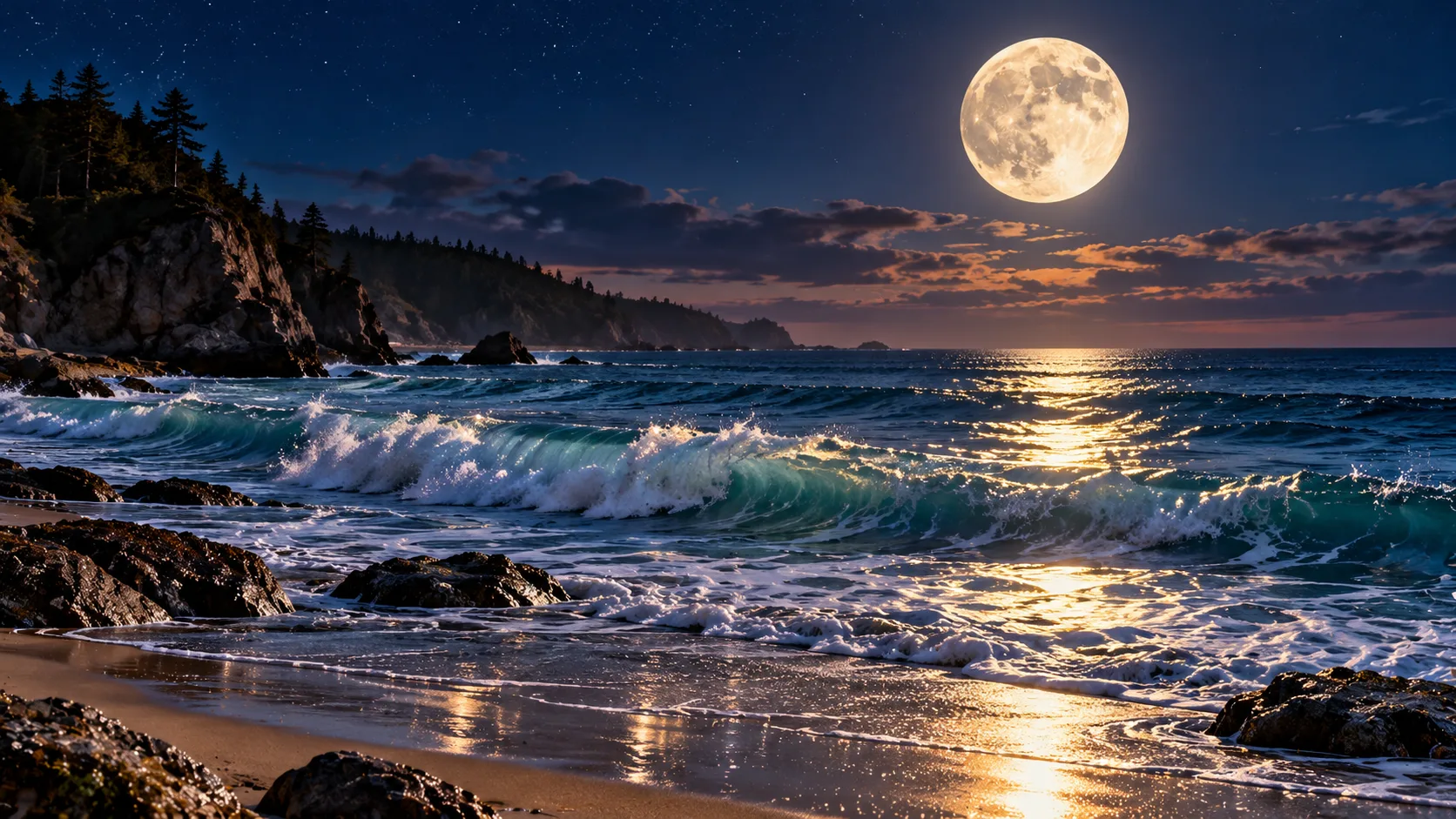
Have you ever visited a beach and noticed that the ocean water moves closer to the shore at certain times of the day? A few hours later, the same beach may look completely different as the water moves farther away. This natural rise and fall of ocean water is called the tide, and the Moon plays the biggest role in creating it. Understanding how the Moon affects Earth’s oceans and tides helps explain one of the most fascinating connections between our planet and its closest natural neighbor.
What Are Ocean Tides and How Do They Work?
Ocean tides are the regular rise and fall of sea levels caused mainly by the gravitational effects of the Moon and Sun. As Earth rotates, different coastlines move through areas of higher and lower ocean water levels. This creates the familiar pattern of high and low tides. However, the exact timing and height depend on local geography and ocean conditions.
High tide occurs when the water level reaches a relatively high point during a tidal cycle. Low tide happens when the water level falls to a relatively low point. Many coastal locations experience two high tides and two low tides during a lunar day. Other places follow different patterns because oceans respond differently to tidal forces.
Tides are not simply waves moving toward and away from beaches. They are large-scale movements and changes in ocean water levels that occur across entire ocean basins. Their effects can be observed along coastlines, in bays, and near river mouths. Scientists study these changes to understand ocean circulation and coastal environments.
Why Does the Moon Have Such a Strong Effect on Earth’s Oceans?
The Moon affects Earth’s oceans because it exerts a gravitational pull on our planet. Gravity is the force that attracts objects toward one another, including Earth and the Moon. Although the Moon is much smaller than the Sun, it is also much closer to Earth. This makes its tide-generating influence stronger than the Sun’s.
The Moon’s gravitational pull is slightly stronger on the side of Earth facing the Moon than on Earth’s center. It is also weaker on the opposite side. These differences create tidal forces that stretch Earth’s oceans into a pattern with two broad bulges. This process forms the basic explanation for ocean tides.
The Moon is approximately 384,400 kilometers from Earth on average, although the distance changes throughout its orbit. Its proximity allows relatively small differences in gravitational attraction to produce noticeable tidal effects. Without the Moon, Earth would still experience tides caused by the Sun. However, their typical range and behavior would be considerably different.
How Does the Moon’s Gravity Create High and Low Tides?
The Moon’s gravity creates tidal forces because its attraction varies across different parts of Earth. On the side facing the Moon, gravitational attraction is stronger than at Earth’s center. This difference contributes to a tidal bulge facing the Moon. Ocean water responds to these forces as part of Earth’s interconnected ocean system.
A second tidal bulge forms on the opposite side of Earth. There, the Moon’s gravitational pull is weaker than it is at Earth’s center. Relative to Earth’s center, this produces an outward tidal effect. The result is a simplified pattern containing two regions of higher water and two regions of lower water.
As Earth rotates beneath this tidal pattern, many coastal areas experience alternating high and low tides. However, the actual ocean response is much more complicated than two fixed water bulges. Continents, water depth, and the movement of ocean waves affect local tides. These factors explain why tidal patterns vary around the world.
Why Are There Usually Two High Tides Every Day?
Many coastal locations experience two high tides because the Moon’s tidal forces produce two broad regions of increased ocean height. One is generally associated with the side of Earth facing the Moon. The other develops on the opposite side. As Earth rotates, coastlines move through these changing tidal regions.
A lunar day lasts approximately 24 hours and 50 minutes, which is longer than a normal solar day. This happens because the Moon moves eastward in its orbit while Earth rotates. As a result, many locations experience high tides roughly 12 hours and 25 minutes apart. The exact timing depends on local tidal conditions.
Not every coastline experiences two equal high tides each day. Some regions have one high tide and one low tide, while others experience two uneven tidal cycles. Scientists describe these patterns as diurnal, semidiurnal, and mixed tides. Their differences result from ocean basin shapes, local geography, and the way tidal waves travel.
What Causes Low Tide in the Ocean?
Low tide occurs when the sea level reaches a lower point in its regular tidal cycle. In the simplified tidal model, these lower-water regions lie between the two tidal bulges. As Earth rotates, coastal locations pass through different parts of this pattern. Water levels consequently rise and fall throughout the day.
During low tide, parts of the shoreline that were previously underwater may become exposed. Beaches can appear wider, and shallow rocks or tidal pools may become visible. The amount of exposed land depends on the local tidal range. Some places experience only small changes, while others have dramatic differences.
Low tide is important for many coastal activities and ecosystems. It creates opportunities to observe tide pools and certain marine animals in their natural habitats. However, exposed coastal areas can become submerged again when the tide rises. Understanding local tide schedules is essential for safe shoreline activities.
How Does Earth’s Rotation Influence Ocean Tides?
Earth’s rotation plays an important role in determining when coastal areas experience high and low tides. Our planet rotates approximately once every 24 hours relative to the Sun. Meanwhile, the Moon continues moving around Earth. This changing relationship produces a tidal schedule that shifts slightly each day.
Because the Moon moves along its orbit, Earth must rotate a little longer to face approximately the same lunar direction again. This creates the lunar day of about 24 hours and 50 minutes. In many locations, corresponding tides occur roughly 50 minutes later each day. However, local conditions can alter this timing.
Earth’s rotation also affects the movement of tidal waves through the oceans. The Coriolis effect influences how moving water changes direction over large distances. Continents and ocean basin boundaries further shape these movements. Together, these processes create complex tidal patterns that scientists study using measurements and mathematical models.
What Role Does the Sun Play in Ocean Tides?
Although the Moon is the main contributor to Earth’s tides, the Sun also produces important tidal forces. The Sun’s gravity affects the entire Earth, including its oceans. However, tidal forces depend strongly on how gravitational attraction changes across Earth’s diameter. Because the Sun is so distant, its tide-generating effect is smaller than the Moon’s.
The Sun’s tide-generating influence is approximately 46 percent as strong as the Moon’s. Its contribution can either strengthen or partly reduce the overall tidal range, depending on the positions of the Sun, Moon, and Earth. These changing gravitational relationships produce noticeable differences throughout the lunar month. They are responsible for spring and neap tides.
Scientists consider both lunar and solar gravity when calculating ocean tide predictions. The combined effects create repeating patterns that change over days and weeks. Local geography then modifies how these forces appear along coastlines. Understanding both celestial bodies is necessary for explaining Earth’s real tidal behavior.
What Are Spring Tides and Why Do They Happen?
Spring tides occur when the Sun, Moon, and Earth are approximately aligned. This happens around the new moon and full moon phases. During these periods, the tidal forces produced by the Sun and Moon reinforce one another. The result is generally a larger difference between high and low water levels.
Spring tides typically produce higher high tides and lower low tides than average. This means the tidal range becomes greater. The word spring does not refer to the season of the year. Instead, it describes the increased movement or rise of ocean water during these tidal conditions.
Spring tides occur approximately twice during each lunar month. Their exact strength depends on the Moon’s distance, solar position, and local ocean conditions. Some coastal areas experience particularly noticeable spring tides because of their geography. These larger tidal ranges can influence coastal flooding, navigation, and marine habitats.
What Are Neap Tides and How Are They Different?
Neap tides happen when the Sun and Moon appear approximately at right angles as viewed from Earth. These conditions occur around the first-quarter and third-quarter moon phases. Their tide-generating effects partly counteract each other. Consequently, the difference between high and low tide is generally smaller than usual.
During neap tides, high water levels tend to be lower than those during spring tides. Low water levels also tend to be higher. This creates a reduced tidal range. Neap tides are part of the normal lunar tidal cycle and occur approximately twice each lunar month.
The difference between spring and neap tides is important for coastal activities. Larger tidal ranges may affect access to certain beaches, harbors, and shallow waterways. Smaller ranges can create different navigation conditions. Understanding these changes helps scientists, coastal communities, and marine operators plan around predictable water movements.
How Do Moon Phases Affect Ocean Tides?
Moon phases describe how much of the Moon’s sunlit surface is visible from Earth. These phases change as the Moon travels around our planet. Although the Moon’s gravitational attraction does not suddenly increase during a full moon, its position relative to the Sun changes. This affects how lunar and solar tidal forces combine.
During new and full moons, the Sun and Moon create spring tide conditions because their tidal effects reinforce each other. During quarter moon phases, neap tides typically develop. These patterns repeat throughout the lunar month. The relationship between moon phases and tides provides a useful way to understand changing tidal ranges.
However, moon phases alone cannot predict the exact height of a tide at a particular beach. Coastline shape, ocean depth, weather, and other factors also influence water levels. Scientists use detailed tidal models to account for these conditions. This explains why identical moon phases can produce different tidal heights in different locations.
How Does the Moon’s Distance From Earth Affect Tides?
The Moon does not travel around Earth in a perfectly circular orbit. Its orbit is slightly elliptical, meaning its distance changes throughout the month. The closest point is called perigee, while the farthest point is called apogee. These distance changes influence the strength of the Moon’s tide-generating forces.
When the Moon is closer to Earth, its tidal influence becomes stronger. This can contribute to larger tidal ranges, especially when perigee occurs near a new or full moon. Such events are sometimes associated with particularly high astronomical tides. However, weather and local geography still determine actual coastal water levels.
When the Moon is farther away, its tidal influence becomes weaker. This can reduce the lunar contribution to the tidal range. These changes happen gradually as the Moon moves through its orbit. Scientists include the Moon’s varying distance when calculating accurate tide predictions for coastal regions.
Why Do Some Places Have Higher Tides Than Others?
Tidal ranges vary greatly around the world because ocean basins have different shapes, depths, and connections. The gravitational forces from the Moon and Sun act globally, but water does not respond equally everywhere. Coastlines, islands, and underwater features influence how tidal waves travel. Some locations naturally experience much larger water-level changes.
Narrow bays and funnel-shaped coastlines can amplify incoming tidal movements. In certain areas, the natural movement of water through an ocean basin can reinforce tidal waves through resonance. These conditions may produce unusually high tidal ranges. Other coastlines experience only modest differences between high and low water.
The Bay of Fundy in Canada is famous for some of the world’s largest tidal ranges. Its shape and natural tidal response help produce dramatic water-level changes. Other regions have much smaller ranges because their geography affects tidal movement differently. These examples show why the same lunar forces produce different coastal experiences.
How Does the Moon Affect Ocean Currents?
The Moon influences ocean currents through the tidal forces it creates. As tides rise and fall, large amounts of water move between different parts of the ocean. This movement generates tidal currents, especially near coastlines, channels, and narrow passages. Tidal currents are one important part of the ocean’s overall circulation.
Tidal currents can become particularly strong where water flows through restricted spaces. Narrow straits and harbor entrances may experience noticeable changes in current direction and speed. These movements often follow predictable tidal cycles. However, local geography and water depth strongly influence their strength.
The Moon does not control every ocean current. Large-scale circulation is also driven by winds, differences in water density, and Earth’s rotation. Tidal currents are one component of this larger system. Understanding their contribution helps scientists explain water movement, sediment transport, and coastal mixing.
How Do Ocean Tides Affect Marine Life?
Ocean tides create changing environments that influence many marine organisms. As water rises and falls, coastal habitats alternate between being submerged and exposed to air. Animals and plants living in these areas must adapt to changing conditions. These environments are known as intertidal zones and support diverse communities.
Crabs, mussels, barnacles, and certain seaweeds are examples of organisms that can live in tidal environments. Some attach firmly to rocks, while others move between sheltered areas as water levels change. Tide pools may temporarily hold seawater after the tide falls. These habitats provide important opportunities for feeding and protection.
Tides also influence the movement of nutrients and small organisms through coastal waters. Tidal currents can transport food particles and help mix water in estuaries. Some marine species coordinate parts of their behavior with tidal cycles. These connections make tides essential to the functioning of many coastal ecosystems.
How Does the Moon Affect Coastal Ecosystems?
Coastal ecosystems depend on regular tidal movements for water exchange and nutrient distribution. Salt marshes, mangrove forests, and tidal flats experience changes in water coverage throughout the day. These conditions influence which plants and animals can survive. The Moon indirectly supports these ecosystems by contributing to the tides.
During high tide, seawater may enter marshes and tidal channels, carrying nutrients and suspended particles. As the tide falls, water drains toward the sea. This movement can transport sediment and organic material. Over time, repeated tidal cycles help shape coastal landscapes and influence habitat conditions.
Tidal wetlands also provide important environmental benefits. They can support fish nurseries, provide habitat for birds, and help protect coastlines from some wave impacts. Their health depends on several factors, including water quality and tidal exchange. Understanding lunar-driven tides helps researchers study and manage these valuable coastal environments.
How Do Tides Affect Fishing and Marine Activities?
Tides influence fishing because water movement can affect where fish and their food sources travel. Some species move into shallow areas during high tide and return to deeper water as levels fall. Tidal currents can also transport small organisms that fish feed on. These patterns vary depending on habitat and species.
Fishers often consider tidal schedules when planning coastal activities. Certain locations may become more accessible during particular water levels. However, favorable fishing conditions depend on many factors beyond the tide. Weather, season, species behavior, and water temperature also influence fishing opportunities.
Tides are equally important for boating, kayaking, and other marine activities. Low water levels can expose underwater hazards, while strong tidal currents may make navigation challenging. Harbors and coastal channels sometimes require careful timing. Checking official tide tables and local safety guidance helps people plan more effectively.
Can the Moon Cause Coastal Flooding?
The Moon can contribute to coastal flooding by producing naturally high tides. During spring tides, the difference between high and low water becomes larger. If unusually high tides combine with unfavorable weather or sea-level conditions, coastal areas may experience flooding. However, lunar gravity alone does not explain every flooding event.
Some especially high tides are commonly called king tides. This informal term generally describes unusually high astronomical tides associated with favorable alignments and orbital conditions. These events can temporarily cover low-lying coastal areas. Their effects become more serious when additional water-level increases occur.
Storm surges, strong winds, and long-term sea-level rise can increase coastal flooding risks. When these conditions coincide with high tides, water may reach farther inland. Scientists monitor the interaction between astronomical tides and weather-related effects. This information helps communities prepare for coastal hazards and improve flood planning.
Does the Moon Affect Waves and Ocean Weather?
The Moon strongly influences tides, but it is not the main cause of ordinary ocean surface waves. Most familiar waves are generated by wind transferring energy to the water. Their size depends on factors such as wind speed, duration, and the distance over which wind blows. Tides and waves are different ocean processes.
Tidal currents can still influence how waves behave near coastlines. When a strong current moves against incoming waves, it may make them steeper or more difficult to navigate. Water depth also changes during the tidal cycle. These changes can affect where waves break and how they reach the shore.
The Moon does not directly control everyday weather patterns such as rain, storms, or wind. Atmospheric conditions are mainly driven by solar heating, pressure differences, and other processes. However, weather and tides can interact to influence coastal water levels. Understanding both systems is important for accurate coastal predictions.
How Do Scientists Measure and Predict Ocean Tides?
Scientists measure tides using instruments called tide gauges. These devices record changes in sea level over time at specific locations. Modern monitoring systems can collect precise measurements automatically. The information helps researchers understand tidal patterns and identify unusual changes in coastal water levels.
Satellites also contribute to ocean monitoring by measuring sea-surface height across large regions. Researchers combine these observations with information about the Moon, Sun, and Earth’s rotation. Mathematical models then calculate how tidal forces interact with ocean basins. These models allow scientists to predict future high and low tides.
Accurate tidal predictions are important for ports, shipping, coastal construction, and environmental management. Tide tables provide expected water levels and times for particular locations. However, actual conditions may differ because of wind, atmospheric pressure, and other influences. Combining predictions with current weather information supports safer coastal decisions.
How Does the Moon Slowly Change Earth’s Rotation?
The Moon’s tidal influence does more than move ocean water. It also contributes to a gradual exchange of angular momentum between Earth and the Moon. Tidal friction occurs as Earth’s rotation interacts with moving ocean water and the solid Earth. This process slowly changes the motion of both bodies.
Over very long periods, tidal friction causes Earth’s rotation to slow gradually. As a result, the average length of a day increases by a small amount over geological timescales. The rate is not perfectly constant because Earth’s oceans and other conditions change. Nevertheless, the effect is measurable through scientific observations.
The Moon is also gradually moving farther away from Earth. Measurements using lunar laser ranging show that its average distance increases by approximately 3.8 centimeters per year. This movement is connected to the exchange of angular momentum. Scientists study these changes to understand the long-term evolution of the Earth-Moon system.
What Would Happen to Earth’s Oceans Without the Moon?
Without the Moon, Earth’s oceans would still experience tides because the Sun produces tidal forces. However, these solar tides would generally be weaker than the combined tidal patterns observed today. Coastal environments would experience different water-level changes. The exact effects would depend on ocean geography and other environmental conditions.
Changes in tidal strength could influence marine ecosystems that depend on regular water movement. Tidal flats, estuaries, and coastal wetlands might develop different patterns of flooding and drainage. Some organisms would face different environmental conditions. However, predicting the full ecological consequences would require complex scientific models.
The Moon also contributes to the long-term evolution of Earth’s rotation and axial orientation. Without it, Earth’s history and environmental development could have followed a different path. Scientists study such possibilities to understand planetary systems. These questions demonstrate how deeply the Moon is connected to Earth’s natural processes.
Why Is Understanding Lunar Tides Important?
Understanding lunar tides helps explain how Earth’s oceans respond to gravitational forces. The Moon’s influence creates regular water-level changes that affect coastlines around the world. Studying these patterns provides insights into the relationship between Earth, the Moon, and the Sun. It also improves our understanding of ocean movement.
Tidal knowledge has practical importance for shipping, fishing, coastal engineering, and environmental conservation. Accurate predictions help people plan activities and recognize potentially dangerous conditions. Scientists also use tidal measurements to monitor long-term changes in sea level. These applications make tidal research valuable beyond astronomy.
The study of ocean tides also reveals how natural systems are connected. Gravitational forces in space can influence marine environments, coastal habitats, and human activities on Earth. Modern research continues to improve tidal models and observations. Understanding these relationships helps communities make better decisions about the coastal environment.
Conclusion
The Moon affects Earth’s oceans and tides through differences in its gravitational pull across our planet. These tidal forces create large-scale ocean movements that produce changing high and low water levels. Earth’s rotation, the Sun’s gravity, and local geography further influence how tides appear along different coastlines.
Ocean tides are important for marine life, coastal ecosystems, navigation, and many everyday activities. Spring and neap tides demonstrate how the positions of the Sun, Moon, and Earth change tidal ranges. Scientists use detailed measurements and models to predict these movements and understand their environmental effects.
The relationship between the Moon and Earth’s oceans is an example of how objects in space influence life on our planet. Although the Moon is hundreds of thousands of kilometers away, its gravitational effects remain visible every day. Understanding these processes helps explain the natural rhythms of Earth’s oceans.
Frequently Asked Questions
How does the Moon control ocean tides?
The Moon creates tidal forces because its gravitational pull varies across Earth. These forces produce large-scale changes in ocean water levels, while Earth’s rotation and local geography determine when high and low tides occur.
Why are there two high tides in one day?
Many coastal areas experience two high tides because lunar tidal forces create two broad regions of increased water height. As Earth rotates, coastlines pass through these regions, usually producing two daily tidal cycles.
Does a full moon cause higher tides?
A full moon often produces spring tides because the Sun, Earth, and Moon are approximately aligned. Their tidal forces reinforce each other, generally creating a larger difference between high and low water levels.
Would Earth still have tides without the Moon?
Yes, Earth would still experience tides because the Sun also produces gravitational tidal forces. However, without the Moon, the typical tidal patterns and ranges would be significantly different from those observed today.
How long does it take for the tide to change?
At many locations, the time between high tide and the following low tide is approximately six hours and twelve minutes. Actual timing varies depending on local geography and the type of tidal pattern.