

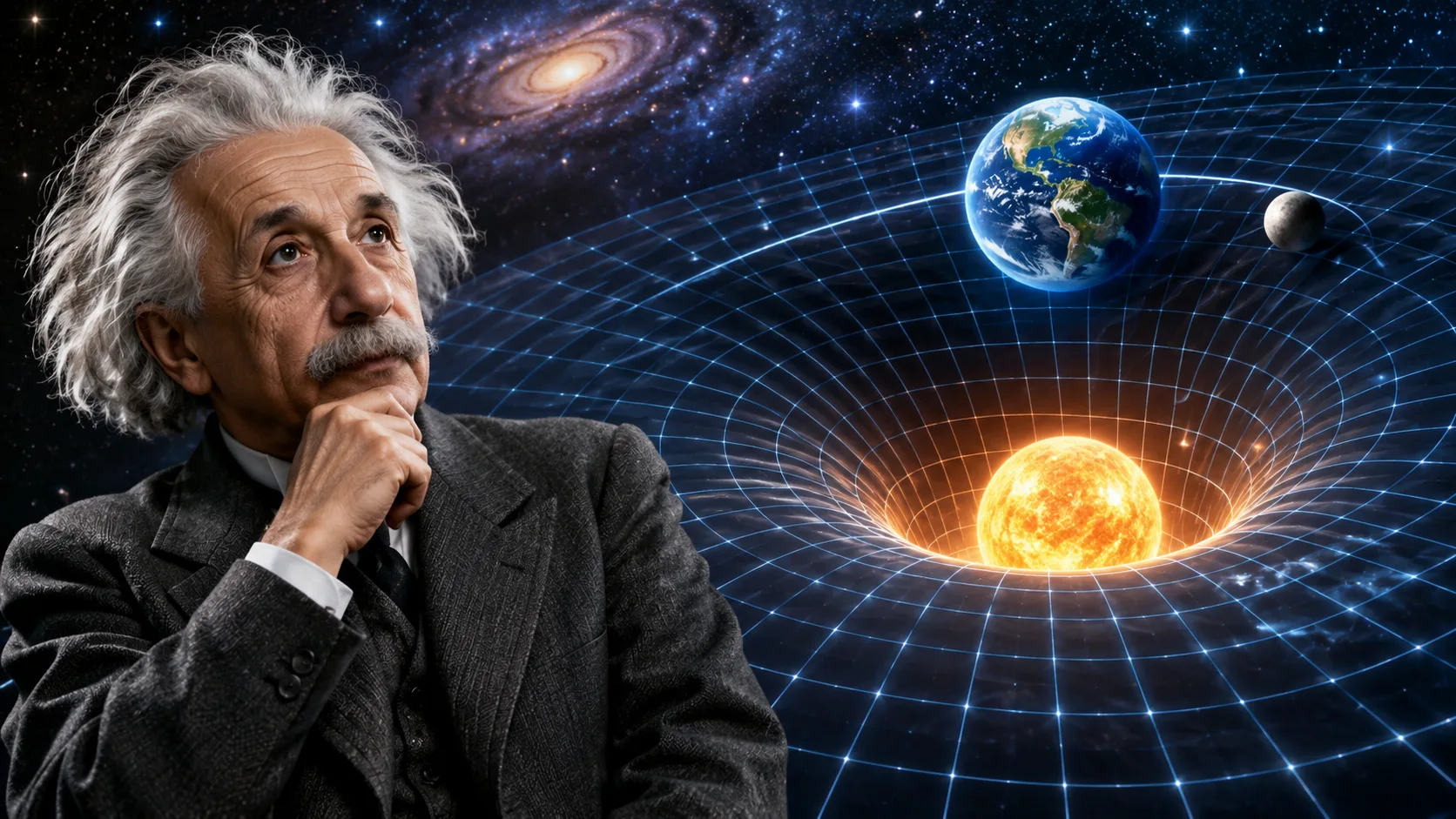
Have you ever wondered why time moves differently in space or how gravity influences the movement of planets? These questions may seem complicated, but they connect to one of the most important discoveries in modern physics. Albert Einstein changed our understanding of the universe by explaining that space and time are not separate things but parts of a connected structure called space-time.
Before Einstein introduced his theories of relativity, scientists generally treated space and time as independent concepts. His discoveries revealed that motion, gravity, and the speed of light influence how distances and time intervals are measured. Understanding space-time helps explain everything from the movement of planets to black holes and the technology used in modern satellite navigation.
What Is Space-Time in Simple Words?
Space-time is the four-dimensional structure that combines the three dimensions of space with one dimension of time. Everything in the universe exists at a particular location and moment within this structure. Scientists use space-time to describe where events happen, when they occur, and how different observers measure the distances and time intervals between them.
In everyday life, we describe locations using directions such as left, right, forward, backward, up, and down. However, knowing where something happens is not always enough to identify an event completely. We also need to know when it occurs, which is why time becomes an essential part of describing the physical universe.
Imagine arranging to meet someone at a coffee shop without mentioning the meeting time. The location would be clear, but the event would remain incomplete because its timing was unknown. Space-time works through a similar principle, connecting information about position and time to create a more complete description of physical events.
How Did Scientists Understand Space and Time Before Einstein?
Before Albert Einstein developed relativity, Isaac Newton’s ideas strongly influenced scientific explanations of motion and gravity. Newtonian physics treated space as a fixed setting in which objects moved and time as something that passed uniformly. This framework successfully explained many everyday physical processes, including falling objects, planetary motion, and the behavior of moving machines.
According to the classical view, two observers could disagree about an object’s speed while still agreeing on the time between events. Space and time were considered independent measurements that did not change with an observer’s motion. This understanding worked extremely well for ordinary speeds, where relativistic differences are too small to notice.
However, scientists eventually encountered questions that classical physics could not fully explain. Experiments involving light and electromagnetic phenomena challenged traditional assumptions about motion and measurement. These developments helped prepare the scientific community for Einstein’s revolutionary explanation of how space, time, and physical observations are connected.
How Did Einstein Explain Space-Time?
Albert Einstein transformed physics through his special theory of relativity in 1905 and his general theory of relativity in 1915. Special relativity showed that measurements of space and time depend on an observer’s motion. General relativity later explained how gravity relates to the geometry of space-time and the movement of matter.
Einstein’s approach challenged the idea that time passes identically for every observer. He demonstrated that observers moving relative to one another can measure different time intervals and distances while still following the same physical laws. These differences are not measurement mistakes but natural consequences of how the universe behaves.
The mathematical description of four-dimensional space-time was developed further by Hermann Minkowski in 1908. His framework combined spatial coordinates and time into a unified geometric model of special relativity. Einstein later used more advanced geometry to describe how mass and energy influence the structure of space-time through gravity.
Understanding the Four Dimensions of Space-Time
The universe is commonly described using three spatial dimensions and one time dimension. Spatial dimensions allow objects to have positions, lengths, widths, and heights, while the time dimension identifies when events occur. Together, these four coordinates provide a useful way to represent physical events within Einstein’s theory of relativity.
Although time is included as a dimension, it does not behave exactly like the three spatial dimensions. In relativity, time and space contribute differently to the mathematical relationship between events. This distinction helps explain why movement through time cannot be treated in precisely the same way as movement across ordinary physical space.
Consider a spacecraft traveling between two planets during a particular mission. Scientists need its spatial position and the time of each observation to describe its journey accurately. By combining these measurements, they can track its path through space-time and calculate how its motion develops throughout the mission.
What Is Einstein’s Special Theory of Relativity?
Einstein’s special theory of relativity describes the relationship between space, time, and motion for observers who are not accelerating. It begins with two important principles concerning the laws of physics and the speed of light. These principles lead to surprising conclusions about measurements that were previously considered fixed and universal.
The first principle states that the laws of physics are the same in all inertial reference frames. The second states that the speed of light in a vacuum has the same value for every inertial observer, regardless of the motion of its source. Together, these ideas require space and time measurements to depend on relative motion.
Special relativity predicts several important effects, including time dilation, length contraction, and the relativity of simultaneity. These effects become more noticeable when objects move at speeds approaching the speed of light. Although they may seem unusual, their predictions have been repeatedly supported by experiments and practical applications.
Why Is the Speed of Light Important in Space-Time?
The speed of light plays a central role in Einstein’s explanation of space-time because it remains constant in a vacuum for all inertial observers. Its value is approximately 299,792 kilometers per second. This remarkable property creates a fundamental relationship between measurements of distance and time throughout the physical universe.
In ordinary experiences, speeds often seem to combine through simple addition. However, light does not follow this familiar pattern when measured by observers moving at different constant velocities. Instead, their measurements of space and time adjust in a way that preserves the same vacuum speed of light.
This principle also establishes an important limit on how quickly information and physical influences can travel. According to relativity, signals cannot propagate faster than light in a vacuum. The speed of light therefore helps determine which events can influence one another and how cause-and-effect relationships operate within space-time.
What Is Time Dilation in Einstein’s Theory?
Time dilation describes how different observers can measure different amounts of elapsed time between events. In special relativity, a moving clock runs slower when compared with measurements made in a reference frame where that clock is moving. The effect depends on relative velocity and becomes significant at speeds approaching the speed of light.
Imagine astronauts traveling in a spacecraft at an extremely high speed relative to Earth. When their journey is compared using an appropriate reference frame, less time may pass for the astronauts than for people who remain on Earth. This difference is a real physical effect predicted by Einstein’s theory.
Scientists have confirmed time dilation through experiments involving precise atomic clocks and rapidly moving particles. Similar timing corrections are important in satellite systems, where both motion and gravity affect clock rates. These observations demonstrate that time is not completely independent of physical conditions and an observer’s path through space-time.
How Does Gravity Affect Space-Time?
Einstein’s general theory of relativity explains gravity through the curvature of space-time rather than treating it only as a conventional force between objects. Mass and energy influence this curvature, which affects how objects and light move. This interpretation provides a deeper explanation of gravitational behavior than the classical description alone.
A common illustration involves placing a heavy ball on a stretched elastic sheet. The ball creates a depression, and smaller balls moving nearby may follow curved paths. Although this picture has limitations, it helps introduce the idea that the geometry of a region can influence the movement of objects.
In the actual universe, gravitational curvature involves four-dimensional space-time rather than a two-dimensional surface. Planets move along paths determined by the geometry surrounding massive objects such as the Sun. General relativity explains this behavior while also predicting effects that Newtonian gravity cannot describe with the same accuracy.
What Does Curved Space-Time Mean?
Curved space-time means that the geometry of the universe can differ from the flat geometry familiar in ordinary mathematical examples. In regions influenced by mass and energy, relationships involving distances, time intervals, and motion change. Einstein’s equations describe how the distribution of matter and energy relates to this curvature.
Objects moving freely through curved space-time follow paths known as geodesics. These paths represent the natural motion of objects when no non-gravitational forces redirect them. For example, an orbiting planet follows a path shaped by the gravitational geometry associated with the Sun and other nearby masses.
Curvature also affects the movement of light, even though light has no rest mass. Light traveling near a massive object can follow a curved trajectory as it passes through the surrounding space-time. Scientists observe this effect through gravitational lensing, which can make distant astronomical objects appear distorted, magnified, or duplicated.
How Does Space-Time Explain the Movement of Planets?
Planetary motion provides one of the clearest examples of how general relativity describes gravity. The Sun contributes strongly to the curvature of space-time in our solar system. Planets follow orbital paths influenced by this geometry, along with the gravitational effects of other objects in the solar system.
Newton’s laws explain planetary orbits with excellent accuracy in many ordinary situations. However, general relativity provides more precise predictions when gravitational conditions or measurement requirements demand additional accuracy. One famous example involves the gradual rotation of Mercury’s elliptical orbit, which classical calculations could not completely account for.
Einstein’s theory successfully explained the previously unexplained portion of Mercury’s orbital precession. This achievement became an important early success for general relativity. It demonstrated that describing gravity through curved space-time could produce measurable predictions that improved upon the traditional Newtonian understanding of planetary motion.
What Is the Relationship Between Space-Time and Black Holes?
Black holes are regions of space-time where gravity is so strong that light cannot escape once it crosses the event horizon. They can form when sufficiently massive stars collapse after exhausting the fuel supporting them. Einstein’s general relativity provides the mathematical framework used to understand their gravitational properties.
The event horizon marks the boundary beyond which signals cannot travel outward to distant observers. Near this boundary, space-time curvature produces effects that differ dramatically from everyday experience. Clocks at different gravitational positions can accumulate different amounts of time, and light traveling outward experiences a gravitational change in frequency.
Black holes are important because they allow scientists to investigate gravity under extreme conditions. Observations of orbiting stars, hot surrounding gas, and gravitational waves provide evidence of their existence. Studying these objects also raises difficult questions about how general relativity connects with quantum physics at extremely small scales.
What Are Gravitational Waves in Space-Time?
Gravitational waves are disturbances in space-time that travel outward from changing distributions of mass and energy. They are especially noticeable when extremely massive objects accelerate in particular ways, such as during the collision of two black holes. These waves carry energy across the universe while producing very small changes in distances.
Einstein predicted gravitational waves through his theory of general relativity in 1916. For many decades, detecting them directly remained difficult because their effects on measuring instruments are extraordinarily small. Scientists eventually developed highly sensitive detectors capable of identifying the tiny changes produced when gravitational waves pass through Earth.
In 2015, the Laser Interferometer Gravitational-Wave Observatory recorded the first direct detection of gravitational waves, announced in 2016. The signal came from merging black holes located far beyond our galaxy. This discovery opened a new way to study cosmic events by observing changes in space-time itself.
How Does Space-Time Affect GPS and Modern Technology?
Space-time is not only an abstract scientific concept because its effects influence technologies used in everyday life. The Global Positioning System relies on satellites that transmit precisely timed signals to receivers on Earth. Accurate positioning requires careful calculations involving the movement of satellites and differences in gravitational conditions.
Satellite clocks experience both special and general relativistic effects. Their motion produces a time-dilation effect, while the weaker gravitational field at satellite altitude causes their clocks to run faster than comparable clocks on Earth’s surface. Engineers account for these competing effects to maintain accurate navigation measurements.
Without appropriate relativistic corrections, GPS positioning errors would grow significantly over time. The system therefore provides a practical demonstration of how Einstein’s ideas influence modern technology. Similar principles are relevant to precision timing, satellite operations, and scientific measurements that require exceptionally accurate synchronization between distant clocks.
How Do Scientists Study and Test Space-Time?
Scientists investigate space-time by measuring how matter, light, and clocks behave under different physical conditions. Observatories, particle accelerators, atomic clocks, and spacecraft provide opportunities to test predictions from relativity. These methods help researchers compare theoretical calculations with real observations rather than relying entirely on mathematical descriptions.
One important historical test involved observing how the Sun’s gravity affects light arriving from distant stars. During a solar eclipse in 1919, astronomical observations provided early support for Einstein’s prediction of gravitational light deflection. Later experiments improved the precision of these measurements and examined additional consequences of general relativity.
Modern research also includes gravitational-wave detection, black hole observations, and increasingly precise clock comparisons. Scientists investigate whether general relativity continues to agree with measurements under different conditions. These efforts are essential because even a highly successful theory must remain open to testing, refinement, and possible discoveries beyond its current explanations.
Can Space-Time Change or Expand?
Space-time is not necessarily static because its geometry can evolve as the universe changes. Modern cosmology describes an expanding universe in which distances between sufficiently separated, gravitationally unbound galaxies generally increase over time. This expansion is a feature of the universe’s large-scale geometry rather than ordinary movement through a fixed surrounding space.
The expansion of the universe does not mean that every physical object continuously becomes larger. Atoms, planets, solar systems, and many galaxies remain bound by forces that dominate over cosmological expansion at their scales. Instead, the expansion becomes most apparent when scientists examine enormous distances between distant galaxies and galaxy clusters.
Observations of distant galaxies and cosmic radiation help researchers investigate how the universe has evolved. These measurements support models describing its history, expansion, and changing energy distribution. Scientists continue studying questions involving dark energy, the early universe, and how space-time behaves under conditions that cannot yet be fully reproduced experimentally.
Why Is Space-Time Important for Understanding the Universe?
Space-time provides a common framework for understanding motion, gravity, and the relationship between physical events. It helps scientists describe how planets orbit stars, how light travels near massive objects, and why different observers measure time differently. These explanations connect many phenomena that previously appeared to belong to separate areas of physics.
Einstein’s theories also changed how scientists approach fundamental questions about the nature of reality. Instead of assuming that everyone shares one universal clock, physicists examine how measurements depend on motion and gravitational conditions. This understanding has influenced astronomy, cosmology, particle physics, and the development of precise measurement technologies.
Despite its success, the modern understanding of space-time remains incomplete in some extreme situations. Researchers continue exploring how gravity relates to quantum mechanics and whether space-time has a deeper microscopic structure. These unanswered questions make space-time an important subject for future scientific investigation and a foundation of modern theoretical physics.
Conclusion
Space-time is the four-dimensional structure that connects the universe’s three spatial dimensions with time. Albert Einstein transformed our understanding of this relationship through his special and general theories of relativity. His work showed that measurements of distance and time depend on motion and that gravity is connected to the curvature of space-time.
Understanding space-time helps explain several remarkable physical phenomena, including time dilation, gravitational lensing, planetary motion, and black holes. It also provides the foundation for understanding gravitational waves and the expansion of the universe. These ideas are supported by scientific observations and influence practical technologies such as satellite navigation.
Although Einstein’s discoveries answered many important questions, scientists continue investigating the deeper nature of space-time. Research involving quantum gravity, black holes, and cosmology may reveal new aspects of how the universe operates. Learning the basic principles of space-time offers a valuable introduction to modern physics and our understanding of reality.
Frequently Asked Questions
What is space-time in simple terms?
Space-time is the four-dimensional framework that combines three dimensions of space with one dimension of time. It helps scientists describe when and where events happen and how motion and gravity influence physical measurements.
How did Einstein discover space-time?
Einstein developed special relativity in 1905 and general relativity in 1915, revealing important connections between space, time, motion, and gravity. Hermann Minkowski later formalized the four-dimensional space-time framework used in relativity.
Does gravity bend space-time?
Yes, according to general relativity, mass and energy influence the curvature of space-time. This curvature affects how objects and light move, explaining gravitational effects such as planetary orbits and gravitational lensing.
Can time move differently in space?
Yes, time can pass at different rates depending on relative motion and gravitational conditions. Atomic clock experiments and satellite navigation systems confirm that these differences are real and measurable.
Is space-time the same as the universe?
No, space-time is the geometric framework used to describe events, motion, and gravity within the universe. The universe also includes matter, radiation, and other physical components that exist and interact within this framework.